
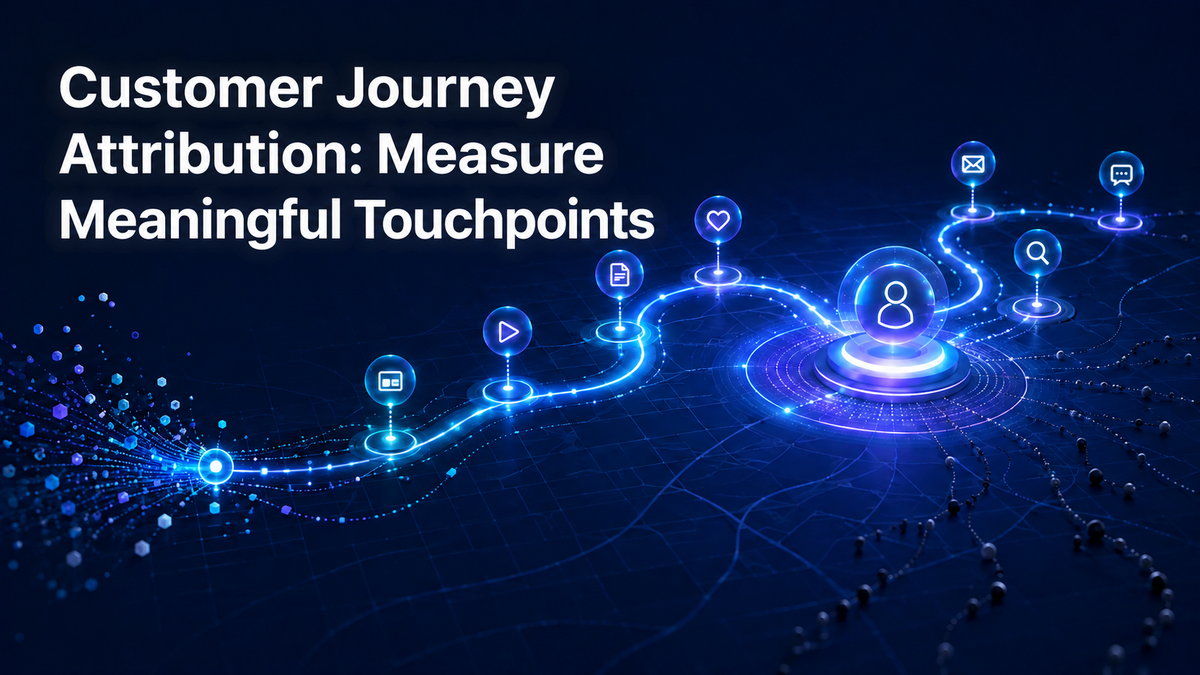
Customer journey attribution connects the touchpoints a customer or account experiences across acquisition, evaluation, conversion, and lifecycle stages. The purpose is not to create a perfectly complete path for every person. It is to identify meaningful, well-defined interactions; show where evidence is strong or weak; and help teams improve the journey without treating a modeled sequence as causal proof.
Key takeaways
- A journey should be designed around business stages and decisions, not only channels and clicks.
- Identity transitions—from anonymous visitor to known lead, customer, user, or account—must be explicit.
- Separate touchpoint capture, journey visualization, attribution rules, and causal validation.
- Use cohorts and segments to avoid averaging fundamentally different journeys into one misleading path.
What belongs in a customer journey
A useful journey starts with outcome milestones: awareness, consideration, lead capture, qualification, sales engagement, purchase or contract, activation, repeat use, expansion, and retention. Then add the interactions that can be credibly observed around those milestones: paid media, organic search, content, email, webinars, product events, sales meetings, customer success activity, referral signals, and support interactions.
Map stages before channels
Teams often start with a channel report and then try to infer the journey from it. Reverse that order. Define the customer or account stages first, decide what counts as a meaningful transition, and specify the system of record. Then map channels and interactions to the transitions they might support.
A journey map should answer
- Which business outcome are we trying to improve?
- Which stages must occur before that outcome?
- Which evidence is captured for each stage, and where?
- Which identifiers connect the stages, and when does the identity become known?
- Which interactions are informative enough to include in attribution reporting?
Design identity resolution carefully
Identity resolution is the bridge between a visit and a longer lifecycle. A user may begin anonymously, identify with an email address, become a CRM contact, later belong to an account, and finally be associated with a transaction or subscription. Record the join method, timing, confidence, and consent boundary. A clear unmatched category is better than an aggressive match that creates fictional journeys.
Choose touchpoints that change the decision
Not every page view deserves equal weight. Focus on touchpoints that represent a meaningful audience, intent, or action: a campaign click, content engagement threshold, pricing visit, webinar registration, sales conversation, trial activation event, cart action, or renewal interaction. The definition should be stable enough to compare over time and visible enough to be challenged.
Avoid the common journey-attribution traps
A beautiful path with unclear coverage
A visual journey can create false confidence if it hides anonymous users, disconnected CRM records, consent-limited sessions, or offline activity. Display coverage, exclusions, and match rates near the analysis.
Double-counting lifecycle moments
A form fill, booking confirmation, CRM lead, and sales-qualified record might describe one underlying progression. Define the business event you will count and deduplicate system events around it.
One journey for everyone
New customers, returning customers, enterprise buying groups, self-serve users, and referral-driven purchasers can have very different paths. Segment the analysis by product, audience, geography, lifecycle, customer value, or sales motion before taking action.
A practical customer journey attribution workflow
- Select one outcome and one segment with enough volume to learn from.
- Map the journey stages and nominate the system of record for each stage.
- Inventory touchpoint sources, identifiers, consent rules, and known coverage gaps.
- Create a journey table that retains timestamps and does not overwrite earlier source data.
- Apply a transparent attribution rule only after the path data is usable.
- Validate the most consequential finding with an experiment, sales feedback, or an aggregate trend check.
Customer journey attribution across business models
For account-level and buying-committee journeys, use B2B Marketing Attribution.
For high-volume consumer journeys, use B2C Marketing Attribution.
For current platform-specific credit rules, see how GA4 attribution models work for SaaS teams.
For product activation and retained revenue, use SaaS Marketing Attribution.
Frequently asked questions
What is customer journey attribution?
It is the process of connecting observed interactions and lifecycle milestones into a path, then assigning or analyzing contribution with stated rules. It is broader than a channel report because it considers the transition from anonymous engagement to business outcome.
How do you track a cross-channel customer journey?
Start with consistent campaign and event capture, then preserve permitted identifiers and join them when the customer becomes known. Use CRM, product, ecommerce, or billing records as appropriate. Document coverage and avoid claiming visibility where it does not exist.
Does customer journey attribution prove causality?
No. It describes recorded paths and can generate strong hypotheses. Use controlled tests, lift studies, holdouts, or aggregate analyses when a causal conclusion will change meaningful investment.
For the full measurement framework, read Marketing Attribution: How to Fix Unreliable Multi-Channel Data.