

Search performance is not a volume game. It is a relevance, clarity, and accessibility game.
At DataXGrowth, we help teams identify the pages with the most unrealized opportunity—then make those pages more useful for people, more understandable for search engines, and easier for AI systems to retrieve and cite.
That means combining traditional SEO with Answer Engine Optimization (AEO): content strategy, on-page optimization, technical cleanup, information architecture, and measurement tied to the pages that matter most.
Recent client work shows what that approach can unlock.
When the Site Is Down, the Right Pages Can Still Grow
A medical-device QMS SaaS client was seeing a broader site-level decline in Google clicks. Rather than treating every page as equally important, we focused on a set of 29 high-opportunity pages.
Over the following 28-day comparison period:
- The 29 optimized pages increased Google clicks by 15.6%.
- The broader site declined by 4.1%.
- The optimized page set generated 486 additional clicks.
- Its share of total site clicks rose from 18.6% to 22.4%.
- Weighted average position improved from 9.77 to 7.67.
- Twenty-two of the 29 optimized pages improved in ranking.
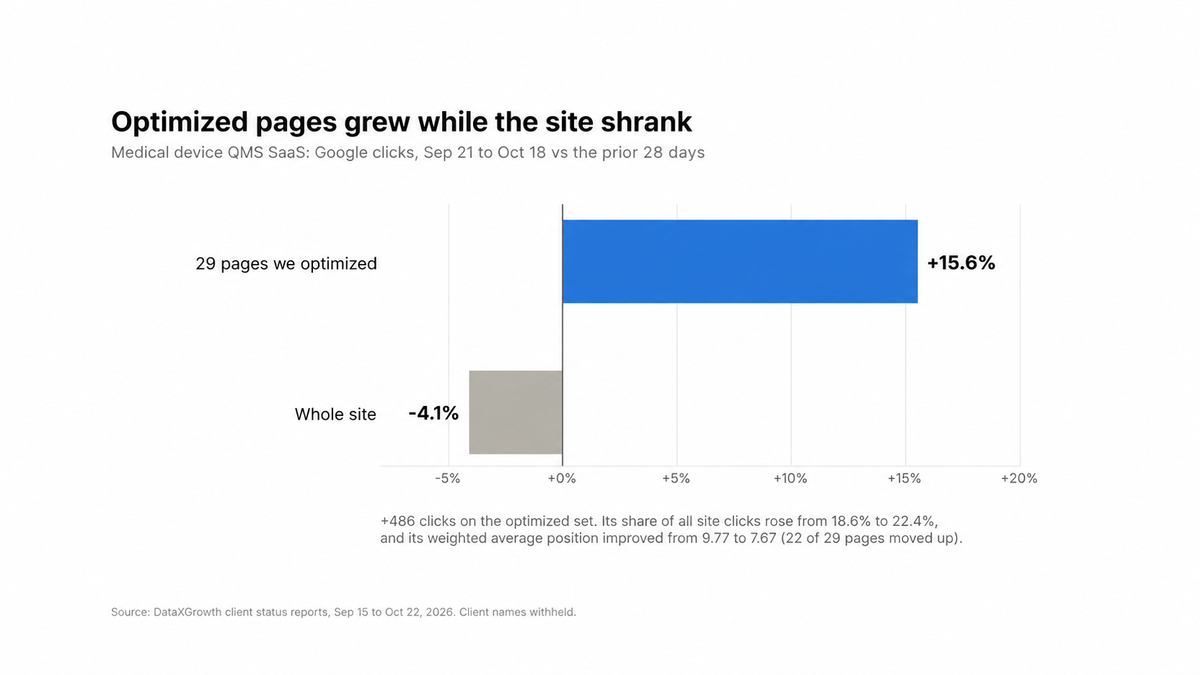
The lesson: a declining site does not mean every page is failing. A focused content strategy can strengthen the pages most likely to create commercial value while broader site issues are addressed in parallel.
Content Refreshes Can Create Meaningful Click Gains
The strongest content opportunities are often already on the site. They may have topical authority, backlinks, impressions, or a useful place in the buyer journey—but lack the clarity, depth, structure, or search-intent alignment needed to perform.
Across client programs, refreshed pages produced substantial click gains:
- A security-hardware parking-lot article rose 333%, from 3 to 13 weekly clicks.
- A DTC bathroom-plants collection page increased 242%, from 26 to 89 clicks.
- A field-operations SaaS platform page increased 139%, from 18 to 43 clicks.
- DTC B2B gifting pages increased 103%, from 37 to 75 clicks.
- A medtech CAPA content cluster increased 93%, from 110 to 212 clicks.
- A cybersecurity bug-bounty page increased 83%, from 2,306 to 4,220 clicks.
- A field-operations non-brand page increased 42%, from 428 to 609 clicks.
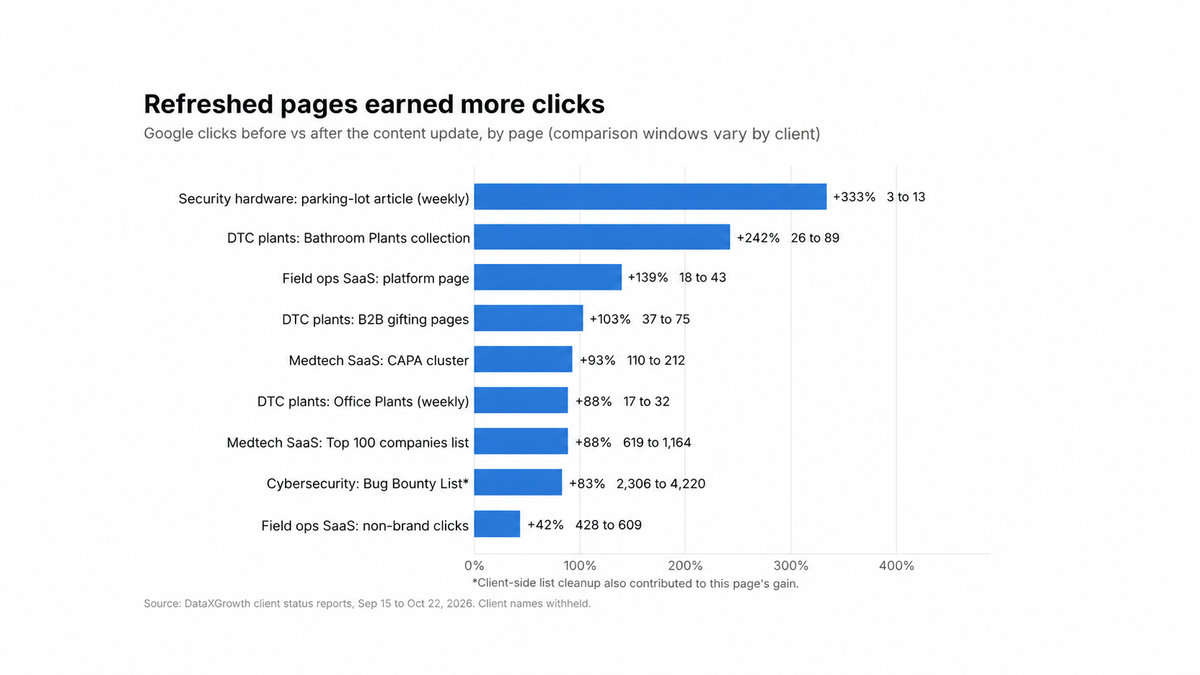
These results do not come from adding keywords. They come from understanding what the audience is trying to accomplish and making the page the clearest, most complete response.
For SEO, that includes better intent alignment, stronger internal linking, purposeful headings, topical depth, useful examples, and improved conversion paths.
For AEO, it also means making answers easy to extract: direct definitions, structured comparisons, concise answer blocks, expert context, clear entity relationships, and content organized around the real questions buyers ask.
Ranking Gains Show What Better Alignment Looks Like
Better content should not merely earn impressions—it should move closer to the top of the results that matter.
Recent updates helped pages move from deeper positions toward page-one visibility:
- An eco-memorial trees page improved from position 47.2 to 16.3.
- A CAPA glossary improved from 36.21 to 6.07.
- A memorial-provider comparison page improved from 35.1 to 8.1.
- A cybersecurity product page improved from 31.5 to 6.8.
- A telehealth exosome-treatment page improved from 17.4 to 8.4.
- A field-operations primer improved from 15.91 to 9.85.
- A field-operations quality-inspection post improved from 14.58 to 7.89.
- A construction-vandalism post improved from 7.5 to 1.9.
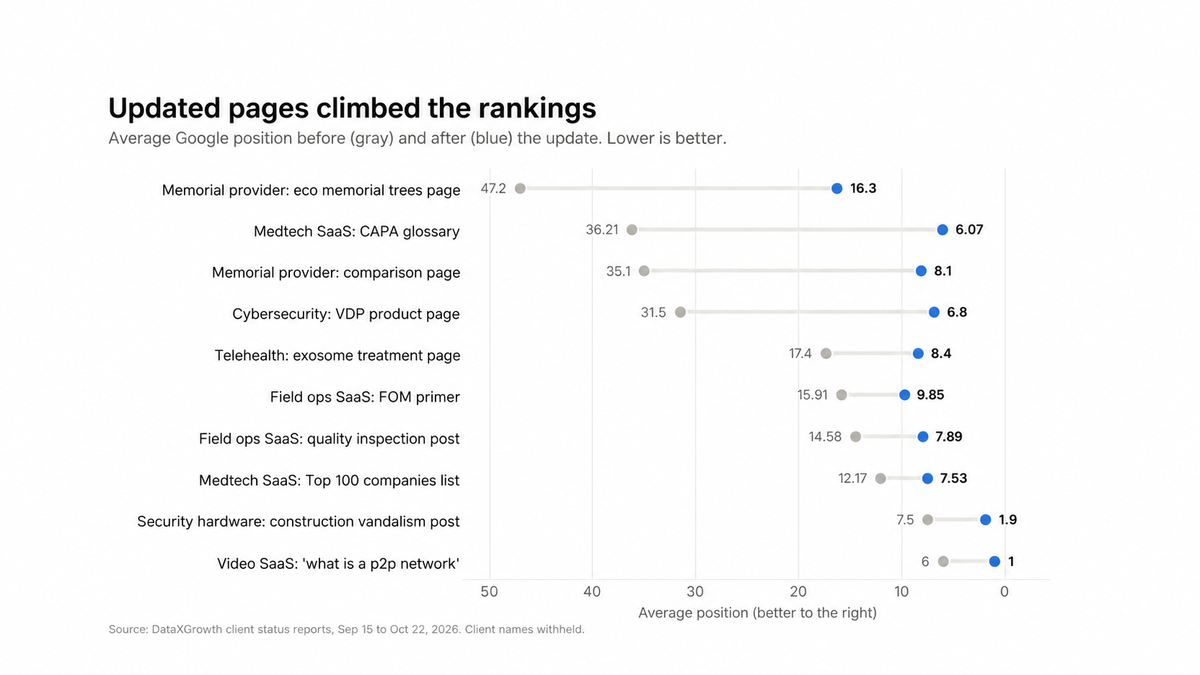
Search visibility is especially valuable when it aligns with high-intent topics: category pages, comparison pages, product pages, educational primers, and resource content that answers a decision-stage question.
Great Content Needs a Technically Accessible Foundation
Even the strongest content cannot perform as well as it should if crawlers cannot access it, the site experience is unstable, or critical technical signals are broken.
That is why content strategy and technical SEO must work together.
Across client engagements, technical fixes removed barriers such as:
- 227 files blocked from AI crawlers, reduced to zero.
- 832 URLs failing cumulative layout shift, reduced to zero.
- 286 mobile URLs needing Core Web Vitals work, reduced to 47.
- Redirected-link issues reduced from 5,440 to 1,023.
- Crawled-but-not-indexed URLs reduced from 2,584 to 825.
- Structured-data errors reduced from 1,415 to 527.
- Homepage HTML weight reduced from 1,819 KB to 1,238 KB.
- Mobile Largest Contentful Paint improved from 3.9 seconds to 2.8 seconds.
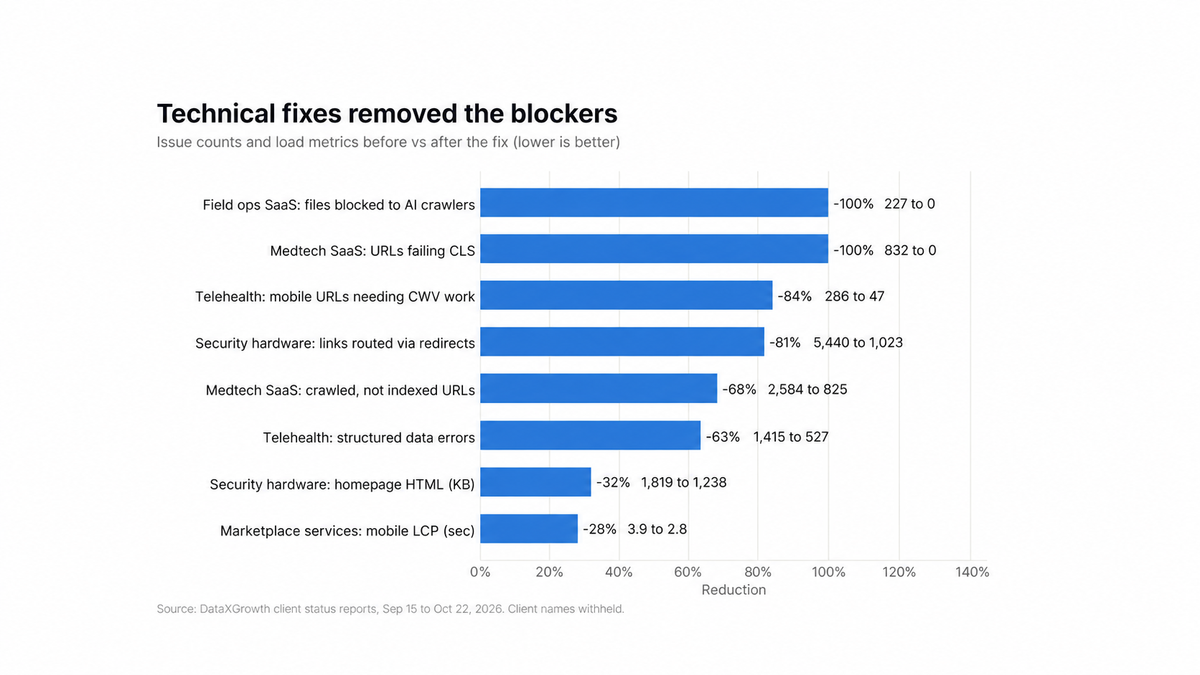
For AEO in particular, technical accessibility matters. AI crawlers and answer systems need to be able to discover, render, interpret, and trust your content. Clear structure, valid markup, fast pages, crawlable assets, and accessible content are no longer background maintenance—they are part of the growth strategy.
The DataXGrowth Approach
We build content programs around opportunities, not publishing quotas.
Our work typically combines:
- Opportunity analysis — finding pages and topics with the highest upside based on search demand, current performance, business value, and competitive gaps.
- SEO and AEO content strategy — mapping the questions, entities, formats, and intent signals that search engines and answer engines need to understand.
- Content optimization and refreshes — improving existing pages before assuming new content is the answer.
- Technical enablement — removing crawl, indexation, performance, structured-data, and AI-access barriers.
- Measurement and iteration — tracking clicks, rankings, visibility, conversions, and the contribution of optimized page groups over time.
The goal is not simply more content. It is a stronger system: the right content, for the right audience, on a site that search engines and AI systems can confidently understand.
If your organic performance has plateaued—or if your best pages are underperforming—DataXGrowth can help identify where focused SEO and AEO optimization can create the next lift.
Results shown are drawn from DataXGrowth client status reports, September 15–October 22, 2026. Client names are withheld. Results vary by client, page, market conditions, and comparison period; past performance does not guarantee future results.