
Most agency status calls look simple on the calendar. The work required to prepare for them is not.
To explain client performance honestly, a strategist may need to compare keyword-ranking files, Google Search Console data, analytics trends, Core Web Vitals, project-management tasks, Slack conversations, meeting notes, and previous client decisions. Each source contains part of the truth. None contains the whole story.
That creates a hidden coordination cost. Before the team can decide what to do, someone has to locate the information, determine which version is current, reconcile overlapping data, separate performance from project status, and translate everything into a usable client update.
This is where connected AI becomes materially more valuable than a standalone chatbot or another dashboard.
A marketing intelligence layer connects the systems an agency already uses, interprets how their information relates, and produces a decision-ready view. The objective is not simply to generate more output. It is to shorten the path from signal to understanding, and from understanding to action.
What Is a Marketing Intelligence Layer?
A marketing intelligence layer is a connected system that gathers performance data and operational context, reconciles conflicting or duplicated signals, and converts the combined evidence into prioritized findings and next actions.
For an agency, that layer sits between three parts of the business:
- Systems of record: Analytics, advertising platforms, SEO tools, CRM data, spreadsheets, project-management systems, communication platforms, and meeting transcripts.
- The intelligence layer: The shared definitions, context, reasoning, quality controls, and prioritization logic used to interpret those systems.
- Systems of action: Client briefs, recommendations, experiments, tasks, alerts, budget decisions, and team communication.
Connecting tools solves an access problem. The intelligence layer solves an interpretation problem.
That distinction matters. Copying information from five tools into one document may make the information easier to find, but it does not determine whether two files measure the same signal, whether a performance change followed a site update, or whether a recommendation is already in progress.
AI’s Highest-Value Role Is Not Producing More Content
Generative AI has made first drafts inexpensive. It can summarize an export, rewrite a paragraph, or turn a list of metrics into polished prose within seconds.
That capability is useful, but it does not resolve the more difficult agency bottleneck: establishing what is true and deciding what matters.
An AI system working from one analytics export can describe the numbers in that export. A connected system can determine that:
- A traffic decline began after a migration discussed in a prior client call.
- A ranking report and a landing-page report are two views of the same underlying change.
- A recommendation has already been assigned in Asana and should not be presented as new work.
- A client question raised in Slack remains unresolved.
- An apparent performance issue is partially explained by a tracking or consent change.
- A strong marketing signal has not yet been translated into an owned next action.
The advantage comes from context, not fluency.
This is also why most isolated AI prompts produce generic marketing advice. Without site changes, project history, business priorities, meeting decisions, and execution status, the model is being asked to recommend action without understanding the operating environment. We explored this limitation in Most AI Marketing Prompts Fail Because They Lack Business Context.
Disconnected Tools Create a Coordination Tax
Most agency tools perform their individual jobs well. The fragmentation appears between them.
Performance platforms answer, “What changed?”
Slack and email help answer, “What is the team discussing?”
Meeting intelligence helps answer, “What did we agree to?”
Asana or another project-management system answers, “What is being worked on, by whom, and by when?”
CRM and pipeline data answer, “Did the marketing activity create qualified business value?”
The account team still has to join those answers together.
When that joining process is manual, several predictable problems appear:
- The most recent metric is paired with outdated project context.
- Multiple exports are treated as independent evidence even when they overlap.
- Completed or active work is repeated as a new recommendation.
- Important decisions disappear inside meeting transcripts or Slack threads.
- Status reports become activity inventories instead of decision tools.
- Senior strategists spend time assembling information that should already be connected.
The agency may have excellent data and still operate slowly because the data does not travel with its context.
A Real Example: What Goes Into One Client Status Update
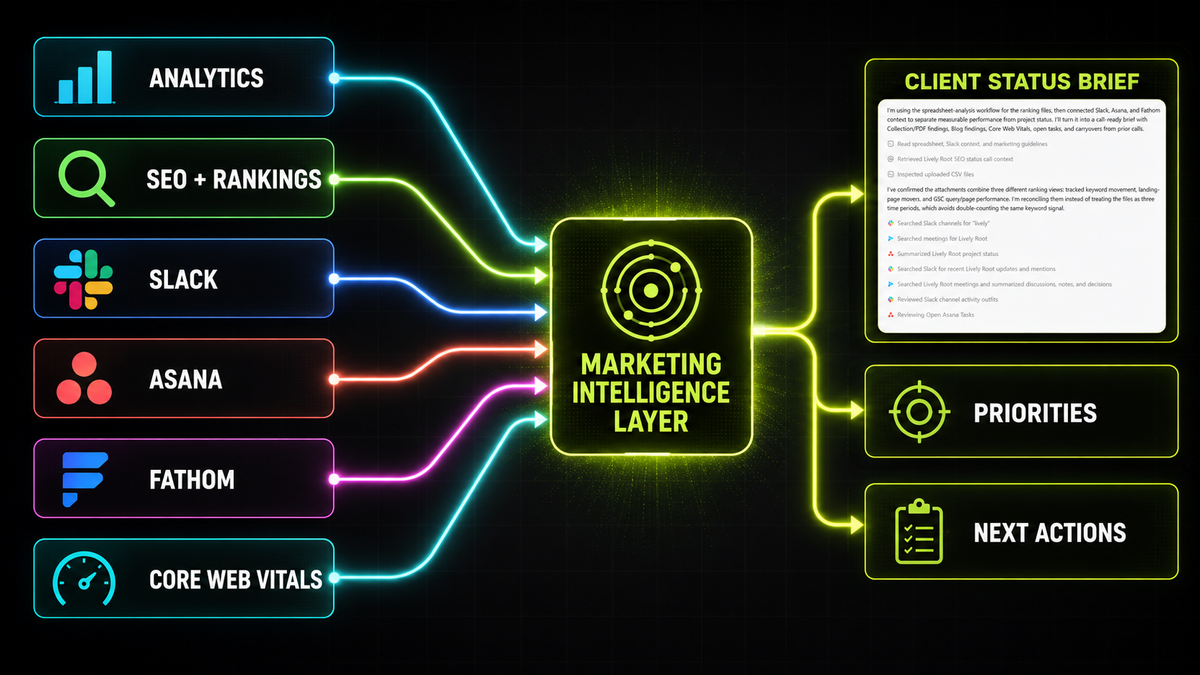
The workflow shown in the hero image came from preparing one SEO client update. The final deliverable needed to cover collection and product-page performance, blog performance, Core Web Vitals, current tasks, and decisions carried over from previous calls.
Creating that brief required several distinct inputs:
- Spreadsheet analysis of multiple ranking and performance files
- Current Slack conversations and team updates
- Open Asana tasks and project ownership
- Previous meeting discussions and decisions
- Technical performance context
- Client-specific reporting priorities
One detail shows the difference between aggregation and intelligence.
The uploaded attachments contained three different ranking views: tracked-keyword movement, landing-page movers, and Google Search Console query and page performance. A basic AI workflow could summarize each file independently. That would risk treating them as three separate periods or counting the same keyword movement several times.
The intelligence workflow instead reconciled the files as related views of the same performance environment. It used each source for the question it could answer without inflating the underlying signal.
The same logic was applied to operational context:
- Slack provided recent questions, blockers, and informal updates.
- Meeting records preserved prior decisions and commitments.
- Asana established whether recommendations were open, active, or complete.
- The performance files showed where measurable movement was occurring.
The result was not a longer summary. It was a more useful one: a call-ready brief that separated measurable performance from project status and made the next decisions explicit.
That is the practical value of a marketing intelligence layer. It does not merely retrieve information from connected tools. It determines what the information means in relation to the rest of the client account.
How Connected AI Reduces Time-to-Output
Agency reporting time is often treated as a writing problem. In reality, most of the effort occurs before the writing begins.
The manual sequence usually looks like this:
- Find the correct files and dashboards.
- Select the relevant reporting period.
- Compare sources and investigate discrepancies.
- Search communication channels for context.
- Review prior meeting commitments.
- Check whether recommended work is already assigned.
- Decide which findings matter to the client.
- Format the result into a consistent update.
Connected AI can compress the repetitive portions of that sequence. It can retrieve the same required inputs each cycle, apply established definitions, flag conflicts, preserve unresolved carryovers, and assemble the first decision-ready version.
The strategist still reviews the evidence and owns the recommendation. The difference is that the strategist begins with a structured account view instead of an empty document and a list of places to search.
The recovered time can move toward higher-value work:
- Investigating why performance changed
- Designing better experiments
- Comparing strategic tradeoffs
- Improving creative or landing-page recommendations
- Preparing the client for a decision
- Identifying opportunities that cross channel boundaries
The relevant efficiency metric is not the number of AI-generated words. It is the reduction in time required to produce a reliable output.
How Connected AI Reduces Decision Latency
Reporting speed matters, but the larger advantage is often decision speed.
A team can identify a meaningful performance signal and still lose weeks before acting on it. The finding may appear in a dashboard, then get discussed in Slack, then wait for a client call, then get converted into a task. At every handoff, context can be lost.
A marketing intelligence layer can preserve the entire decision chain:
- Signal: What changed?
- Evidence: Which sources support the finding?
- Context: What business, site, campaign, or project event may be relevant?
- Interpretation: What does the change likely mean?
- Decision: What should the team approve, reject, investigate, or test?
- Action: Who owns the next step?
- Feedback: What happened after the action was completed?
This creates a continuous feedback loop instead of a series of disconnected reports.
It also changes the role of the status update. The update stops being a record of activity and becomes an operating document for the next decision.
What This Changes for Agency Teams
More Strategic Capacity
Reducing manual retrieval and synthesis gives senior team members more time for analysis, client strategy, and experimentation. The system is handling repeatable coordination work, not replacing strategic responsibility.
More Consistent Client Delivery
When the required sources, quality checks, and output structure are encoded into the workflow, reporting quality depends less on one account manager remembering every detail.
Fewer Missed Commitments
Prior decisions and open tasks can remain attached to the current account view. Teams are less likely to repeat the same conversation or allow an approved action to disappear between meetings.
Clearer Accountability
Recommendations become more actionable when each one includes supporting evidence, current status, an owner, and the next required decision.
Better Agency Scalability
Adding clients normally adds reporting and coordination overhead. A reusable intelligence workflow reduces the amount of manual work that must grow linearly with every new account.
Stronger Client Trust
Clients do not need more metrics. They need confidence that the agency understands the relationship between performance, completed work, current constraints, and the next priority.
What Agencies Should Not Automate Blindly
Connected AI should accelerate judgment without manufacturing certainty.
Several controls remain necessary:
- Every material claim should retain a path back to its evidence.
- Observed facts should be separated from inferred causes.
- Missing, delayed, or conflicting data should be visible.
- Client-specific definitions should take precedence over generic benchmarks.
- Budget changes and strategic commitments should require human approval.
- Access should follow client, role, and system permissions.
- Final accountability should remain with the team making the recommendation.
AI can identify that rankings declined after a site release. It should not state that the release caused the decline unless the evidence supports that conclusion.
It can show that a task is overdue. It cannot determine the organizational tradeoff behind that delay without additional context.
It can propose a next step. The agency still decides whether that step is commercially, technically, and politically realistic.
How to Build the First Agency Intelligence Workflow
Agencies should not begin by connecting every tool they own. They should begin with one repeated decision process.
1. Choose a High-Frequency Workflow
Weekly or monthly client status preparation is a strong starting point because it is repeated, measurable, and dependent on multiple sources.
2. Map the Decisions, Not Just the Data
Document what the team must decide at the end of the workflow. Then work backward to the evidence and context required for those decisions.
3. Establish Sources of Truth
Define which system owns each metric, task state, decision, and client commitment. More sources do not automatically produce more certainty.
4. Encode Reconciliation Rules
Specify how the workflow should handle overlapping reports, conflicting dates, attribution differences, missing data, and duplicated signals.
5. Design a Decision-Ready Output
The final format should separate:
- Performance findings
- Explanatory context
- Current project status
- Risks and unknowns
- Recommended decisions
- Owners and next actions
6. Keep Human Review in the Loop
Run the connected workflow beside the existing manual process until the team trusts the retrieval, reconciliation, and prioritization logic.
7. Measure the Right Outcomes
Track preparation time, revision rate, unsupported claims, missed carryovers, time from signal to assigned action, and time required to reach a client decision.
Once the workflow is reliable, the agency can expand into campaign reviews, content prioritization, CRO roadmaps, budget pacing, pipeline analysis, and cross-channel growth planning.
Connected Tools Are Infrastructure. Connected Decisions Are the Advantage.
The modern agency does not need another place to look for information. It needs a system that reduces the number of places the team has to search before making a decision.
Analytics, Slack, Asana, meeting intelligence, SEO platforms, advertising systems, and CRM data each remain valuable. Their combined value increases when a marketing intelligence layer understands their roles, reconciles their signals, and connects the resulting insight to execution.
That is the practical opportunity for AI in agency operations.
Not more output for its own sake.
Less time assembling context. Less duplication. Fewer lost decisions. Faster movement from evidence to action.
DataXGrowth AI is designed to create that connected intelligence layer across marketing performance, project context, meetings, and execution. For teams that first need to identify where growth is being constrained, a Growth Opportunity Audit can establish the priorities the intelligence system should monitor.
Frequently Asked Questions
What is marketing intelligence for agencies?
Marketing intelligence for agencies is the process of combining client performance data with business context, project activity, communication, and decision history so teams can identify priorities and act on them faster.
How does connected AI improve agency reporting?
Connected AI reduces repetitive information gathering, reconciles related data sources, preserves prior decisions, and creates a structured first version of the client update. The agency team still validates the evidence and owns the final recommendation.
Which tools should an agency connect first?
Start with the systems required for one repeated decision workflow. For client reporting, that usually includes the primary analytics source, project-management platform, communication channel, meeting record, and the performance platform most relevant to the engagement.
Does a marketing intelligence layer replace account managers or strategists?
No. It reduces repetitive retrieval, reconciliation, and formatting work. Account managers and strategists remain responsible for causal reasoning, client judgment, tradeoffs, communication, and final decisions.
How should an agency measure the value of connected AI?
Measure preparation time, revision rate, missed action items, time from signal to owner, decision turnaround time, and the percentage of recommendations supported by traceable evidence. Output volume alone is not a useful success metric.