
Most growth teams do not have an idea shortage. They have a prioritization problem.
SEO recommends more content. Paid media recommends more budget. CRO recommends a new landing page. Sales says lead quality is weak. Analytics says the tracking cannot be trusted. Product wants a clearer activation path. Every observation may be partly correct, but acting on all of them at once creates more activity without proving which constraint matters most.
A Growth Opportunity Audit is designed to resolve that problem. It reviews the connected growth system, identifies where momentum is being lost, and ranks the changes most likely to improve qualified pipeline, revenue, customer acquisition, or retention.
The output is not another unfiltered list of marketing ideas. A useful audit gives the team an evidence-backed order of operations: what to fix now, what to test next, what to monitor, and what should wait.
What is a Growth Opportunity Audit?
A Growth Opportunity Audit is a structured assessment of the strategy, data, channels, customer journey, and technology that influence growth. It looks across the full system rather than evaluating one marketing channel in isolation.
At DataXGrowth, the audit is built to answer three practical questions:
- What is already working and should be protected or expanded?
- Where is growth leaking because of a strategic, measurement, acquisition, conversion, visibility, or technical constraint?
- Which opportunities deserve resources first based on impact, evidence, effort, dependencies, and time to value?
This is not a financial-statement or regulatory audit. It is a commercial growth diagnostic. The goal is to help a team make better decisions about where to invest attention, budget, and execution capacity.
The DataXGrowth Growth Audit can stand alone as a decision document. A company can implement the roadmap internally, hand specific briefs to existing partners, or engage DataXGrowth for focused execution after the audit.
Why a channel audit can miss the real constraint
SEO, paid acquisition, analytics, and CRO audits are valuable when the problem is already known and contained. A technical SEO audit can identify crawling and indexing issues. A paid media audit can expose inefficient campaign structure. A CRO audit can find friction in a landing page or checkout flow.
The limitation is scope. A channel audit usually optimizes the area it can see.
For example, a paid search account may appear to need more budget because high-intent campaigns are reaching their caps. A broader review may show that the landing page is misaligned with the search terms, conversion tracking is double-counting form submissions, and the CRM is not distinguishing qualified opportunities from low-value leads. Increasing spend before correcting those issues would scale uncertainty and waste.
A Growth Opportunity Audit evaluates the handoffs between systems. It asks whether the strategy, audience, offer, acquisition source, landing experience, measurement, sales follow-up, and downstream customer value support the same growth objective.
That connected view is what separates a growth audit from a collection of channel checklists.
What DataXGrowth reviews in a Growth Opportunity Audit
The scope is calibrated to the company, its business model, and the decision it needs to make. A SaaS company preparing to increase demand generation requires a different emphasis than an ecommerce brand trying to improve acquisition efficiency or a startup validating its first repeatable go-to-market motion.
The review typically covers six connected dimensions.
1. Growth strategy and go-to-market
The audit begins with the business context. DataXGrowth reviews the growth objective, ideal customer profile, buying committee, offer, positioning, pricing, sales motion, channel strategy, and execution constraints.
The purpose is to determine whether the current marketing system is designed around a clear commercial outcome. If the objective is vague, the KPI tree will be vague. If the ICP is too broad, channel performance and lead quality will be difficult to interpret. If the offer does not match buyer readiness, more traffic may not create more qualified action.
Questions may include:
- What business outcome must change in the next 90 days?
- Which customer segment has the strongest combination of pain, budget, reachability, and buying speed?
- What action should each audience take at its current stage of awareness?
- Does the offer create a credible reason to act now?
- Can the sales and delivery teams support the volume marketing is expected to generate?
2. Demand generation and acquisition
DataXGrowth reviews how the company creates and captures demand across paid, organic, content, lifecycle, referral, partner, and other active acquisition channels.
The objective is not to label a channel good or bad based on surface-level metrics. The audit evaluates traffic quality, cost, conversion, lead or customer quality, downstream contribution, and the role each channel plays in the customer journey.
This can uncover situations such as:
- A channel generating inexpensive leads that rarely become qualified opportunities
- High-intent demand that is underfunded while low-intent campaigns absorb budget
- Strong content visibility with weak paths to product or sales conversion
- Paid creative and landing-page messaging that attract different audiences
- Lifecycle or retargeting gaps that force every campaign to convert on the first visit
3. Analytics, attribution, and measurement
Growth decisions are only as reliable as the measurement beneath them. The audit assesses GA4, Google Tag Manager, conversion events, campaign tracking, CRM handoffs, attribution, dashboards, and KPI definitions.
DataXGrowth looks for missing events, duplicate conversions, inconsistent channel definitions, broken UTMs, disconnected lead stages, unreliable revenue attribution, and dashboards that optimize for activity rather than business outcomes.
If the data is unreliable, that is not a reason to stop the audit. It is a finding. The report separates what can be trusted, what can be used directionally, and what must be repaired before the team increases spend or changes strategy.
4. SEO, AEO, and content visibility
The audit reviews whether the company can be discovered when buyers search in Google, use AI answer engines, compare alternatives, or research the problem the product solves.
The assessment can include technical SEO, search intent, non-brand visibility, content gaps, topic coverage, internal linking, page structure, schema, answer readiness, competitive visibility, and the connection between content and conversion paths.
The goal is not simply more traffic. It is stronger visibility across the questions and decisions that can create qualified demand.
5. Customer journey and conversion
Traffic has limited value if the website does not help the right visitor move forward. DataXGrowth reviews landing pages, calls to action, forms, proof, navigation, mobile experience, offer clarity, checkout or demo flows, and other points where buying momentum can be lost.
Available behavioral data, such as funnel reports, path analysis, session recordings, heatmaps, form performance, and user feedback, is used to distinguish observed friction from opinion.
The output includes focused conversion hypotheses and A/B test ideas, not a generic instruction to redesign the website. A full redesign is only justified when the evidence shows that smaller changes cannot address the underlying constraint.
6. Growth technology, execution, and AI readiness
The audit examines whether technology accelerates growth or creates drag. This can include site performance, Core Web Vitals, integrations, automation, data flow, tool overlap, technical backlog, workflow design, and AI opportunities.
A company may have the right strategy but still move slowly because tracking repairs, landing-page changes, schema, integrations, or reporting requests remain stuck between teams. DataXGrowth identifies those dependencies so the roadmap reflects what can actually be shipped.
The AI review also distinguishes useful applications from novelty. The relevant question is not, "Where can we add AI?" It is, "Where would better signal detection, context synthesis, analysis, or workflow delivery improve a recurring growth decision?"
The evidence used to identify growth opportunities
A strong audit combines four forms of evidence.
Business evidence
This includes the business model, unit economics, growth goals, pricing, market position, sales motion, budget, team capacity, seasonality, and operational constraints. These inputs determine whether a recommendation is commercially realistic.
Quantitative performance evidence
Relevant sources may include GA4, Google Search Console, paid media platforms, CRM data, marketing automation, ecommerce or product analytics, conversion tracking, pipeline reporting, cohort data, and existing dashboards.
Customer and market evidence
Sales notes, win-loss patterns, customer interviews, reviews, surveys, support tickets, search behavior, competitor positioning, and customer objections help explain why performance moved. Metrics show behavior. Customer evidence helps interpret it.
Operational evidence
Campaign briefs, launch dates, website releases, project status, meeting decisions, budget changes, sales follow-up, technical blockers, and team capacity reveal what was happening inside the business when a metric changed.
These sources do not always agree. The audit should document those conflicts rather than hiding them. A defensible recommendation separates observed facts, interpretations, assumptions, and missing information.
How the DataXGrowth Growth Audit process works
The process follows a simple operating sequence: establish context, diagnose the constraint, prioritize the opportunities, build the roadmap, and measure what happens next.
1. Establish the growth context
The initial discovery phase aligns the audit with a specific business decision. DataXGrowth reviews the company's goals, target customers, current go-to-market motion, funnel, active channels, known performance concerns, and execution constraints.
The audit is more useful when the objective is measurable. "Improve marketing" is too broad. "Increase qualified demo pipeline without raising cost per qualified opportunity" creates a decision frame that can guide the analysis.
2. Validate the available data
Before drawing conclusions, DataXGrowth assesses the quality, completeness, and consistency of the available data. Platform totals may not reconcile because of attribution rules, consent, duplicate events, CRM definitions, time zones, or broken integrations.
The audit identifies which data is canonical for each decision and where confidence must be limited. This prevents false precision from turning into an expensive recommendation.
3. Diagnose the constraints
The analysis looks for the point where growth loses momentum. The constraint may be insufficient demand, poor audience fit, weak positioning, an unconvincing offer, inefficient acquisition, broken measurement, landing-page friction, sales follow-up, retention, technical execution, or a combination of factors.
The objective is causal discipline. A declining conversion rate is a signal, not a diagnosis. The audit considers plausible explanations, the evidence for and against each one, and the smallest next action that can reduce uncertainty.
4. Prioritize the opportunities
Findings are ranked using factors such as:
- Expected business impact
- Strength and freshness of supporting evidence
- Confidence in the diagnosis
- Execution effort and cost
- Dependencies and risk
- Time to value
- Urgency and reversibility
This step prevents a large project from automatically outranking a smaller, better-supported change. Fixing a broken conversion event or clarifying a high-intent offer may create more immediate value than launching another channel.
5. Build the roadmap and measurement plan
The final report converts the findings into a practical 30-, 60-, and 90-day sequence. Each priority should have a clear rationale, owner, dependency, KPI, and next decision.
Early work typically protects measurement and removes critical friction. The middle phase launches the highest-confidence experiments. The later phase scales validated opportunities, expands coverage, or addresses larger structural changes.
The roadmap should remain adaptable. A recommendation is a hypothesis until market, customer, or performance evidence validates it.
What the team receives
A DataXGrowth Growth Opportunity Audit is designed to make the work executable. Every audit includes a Growth Readiness Score across strategy, acquisition, measurement, conversion, visibility, and technology. Depending on scope, the final report can also include:
- An executive summary of growth potential, strengths, and primary constraints
- A ranked growth opportunity map
- Funnel, customer journey, and conversion findings
- Analytics, attribution, and tracking repairs
- SEO, AEO, and content recommendations
- Demand-generation and channel opportunities
- Landing-page improvements and experiment ideas
- Growth technology, automation, and AI opportunities
- Recommended primary and guardrail KPIs
- A 30-, 60-, and 90-day roadmap
- Suggested owners, dependencies, and next steps
The deliverable is useful only if the team can act on it. Recommendations should be specific enough to become a project brief, experiment card, analytics repair, content update, or channel decision.
When a Growth Opportunity Audit is most valuable
An audit is especially useful when a company is about to make a decision that will be expensive to reverse.
Common triggers include:
- Increasing paid acquisition or entering a new channel
- Redesigning or migrating a website
- Changing positioning, pricing, or go-to-market strategy
- Launching a new product, offer, market, or customer segment
- Building a larger SEO, AEO, or content program
- Hiring a growth leader, agency, or specialized channel team
- Implementing new analytics, CRM, automation, or AI technology
- Reconciling dashboards that tell conflicting performance stories
- Investigating traffic growth that is not producing qualified pipeline or revenue
- Responding to stalled growth without a clear diagnosis
A broad audit is not always the right starting point. If the company already knows the exact problem and only needs a narrow technical review, a focused SEO, analytics, CRO, paid acquisition, or implementation engagement may be faster and more efficient.
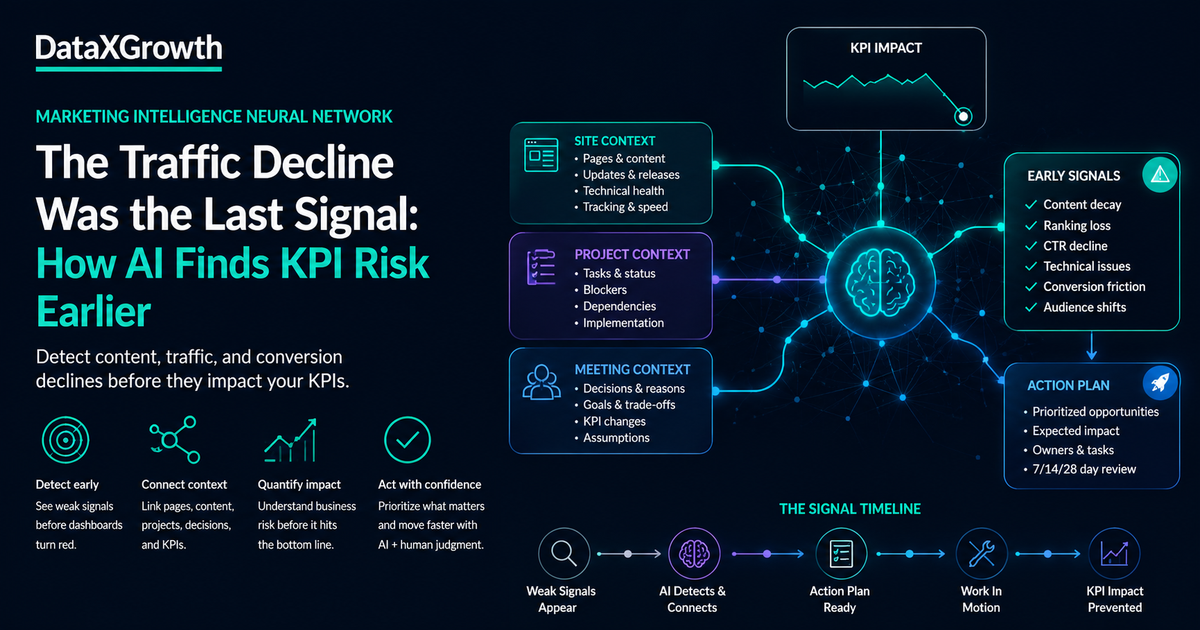
How AI can extend the value of the audit
A Growth Opportunity Audit is a point-in-time diagnostic. For teams with multiple active channels, frequent launches, complex reporting, or substantial operational context, the next problem is maintaining that clarity as conditions change.
DataXGrowth AI provides an optional marketing intelligence layer within DataXGrowth's consulting engagements. It is not a self-serve dashboard or an autonomous system that changes campaigns without approval.
The system connects quantitative performance with authorized qualitative and operational context. Depending on the engagement and available integrations, that may include analytics, search, paid media, CRM, lifecycle, revenue data, Slack, Asana, meeting transcripts, campaign briefs, and strategy documents.
The purpose is to help answer four recurring questions:
- What materially changed?
- Why does the change matter for this business?
- What evidence supports the interpretation?
- What should the team do next?
The audit provides the initial business context, KPI definitions, constraints, and priority roadmap. DataXGrowth AI can then help monitor the relevant signals, connect performance changes to launches or decisions, surface evidence, and prepare prioritized recommendations for expert review.
This option is most useful when the cost of slow or fragmented decision-making is meaningful. A smaller team with one channel and a narrow problem may get sufficient value from the standalone audit and a simple measurement cadence.
AI does not replace the strategist's accountability. DataXGrowth specialists review the evidence, assess commercial relevance, and approve recommendations before they move into a client dashboard, Slack update, or project workflow.
Common misconceptions about growth audits
"The audit will tell us to do more marketing."
Not necessarily. It may recommend stopping low-value activity, repairing measurement, narrowing the ICP, simplifying the offer, or delaying spend until the conversion path is ready.
"The longest list of findings is the best audit."
Finding volume is not decision quality. A short roadmap with a defensible sequence is more valuable than 100 observations without impact, evidence, ownership, or timing.
"Every recommendation is guaranteed to work."
No audit can remove market uncertainty. It can improve the quality of the hypothesis, reduce avoidable mistakes, and define a faster way to test what is true.
"We need perfect analytics before we start."
No. The audit can use trustworthy data where it exists, apply directional evidence where appropriate, and make data repair an explicit priority. It should not disguise unreliable data as certainty.
"The audit requires a long-term engagement."
No. The roadmap can be implemented by an internal team or existing partners. Continued DataXGrowth support is optional.
Frequently asked questions
What are the four types of growth opportunities?
The Ansoff Matrix groups growth into four paths: market penetration, selling more of the current offer to the current market; market development, taking the current offer to a new market; product development, creating a new offer for the current market; and diversification, entering a new market with a new offer.
A Growth Opportunity Audit does not assume all four are equally attractive. It evaluates customer evidence, economics, competitive conditions, execution capacity, and time to value to determine which path deserves testing.
How do you assess a growth opportunity?
Start with a measurable business objective, establish the performance baseline, identify the likely constraint, estimate the potential impact, test the supporting evidence, account for effort and dependencies, and define the smallest experiment that can validate or reject the opportunity.
The assessment should distinguish potential from confidence. A large theoretical market can still be a low-priority opportunity if the company lacks proof, access, differentiation, or the capacity to execute.
How is a Growth Opportunity Audit different from an SEO or CRO audit?
An SEO or CRO audit examines one discipline in depth. A Growth Opportunity Audit reviews how strategy, acquisition, measurement, visibility, conversion, and technology work together, then prioritizes across those areas. If the constraint is already known, a focused audit may be the more efficient choice.
Can DataXGrowth complete an audit if our analytics are unreliable?
Yes. Data quality is evaluated as part of the process. DataXGrowth documents what can be trusted, flags gaps and inconsistencies, and prioritizes the repairs required for more defensible decisions.
Does the Growth Opportunity Audit include AI?
The audit includes a review of growth technology, automation, and relevant AI opportunities. DataXGrowth AI is an optional, consulting-led intelligence layer for teams that want ongoing monitoring and context-aware recommendations after the initial audit.
What happens after the audit?
The team can implement the roadmap internally, translate recommendations into briefs for current partners, or ask DataXGrowth to support focused sprints, channel work, or a fractional growth engagement. The audit remains a standalone deliverable.
Find the constraint before you scale the activity
Growth becomes expensive when a team acts on disconnected observations without understanding the system behind them.
A Growth Opportunity Audit creates the missing decision layer. It connects business context, performance data, customer evidence, and operational reality; identifies the most important constraints; and turns the findings into a prioritized roadmap.
Start with a DataXGrowth Growth Audit to identify what is working, where growth is leaking, and what to prioritize next.
If your team also needs an ongoing intelligence layer that connects marketing performance with business and project context, explore DataXGrowth AI.