

Choosing between ChatGPT 6 and Claude Fable 5.1 is not simply a question of which model is smarter. A marketing team needs accurate analysis, usable content, reliable execution, and appropriate controls. The best choice is the product and model configuration that meets those requirements with an acceptable review burden and operating cost.
This guide separates documented specifications from vendor-reported results and our proposed evaluation framework. It is a researched comparison, not a completed DataXGrowth head-to-head benchmark. The sample prompts and reference responses below are illustrative, use fictional or synthetic inputs, and are not captured outputs from Claude or a controlled ChatGPT-versus-Claude test. Facts checked September 6, 2026.
What is the difference between ChatGPT 6 and Claude Fable 5.1?
ChatGPT is OpenAI's application; GPT-6 Astra is a model available through its products and API. Claude is Anthropic's application; Fable 5.1 is a specific model. We use “ChatGPT 6” as familiar shorthand, but the distinction matters. OpenAI's Astra announcement and Anthropic's Fable documentation describe the underlying models and their availability.
The practical comparison has three layers: what the model can reason about, what its surrounding application can retrieve or execute, and what your organization permits it to do. A good answer inside a chat window does not establish that the same setup can update your CMS, reconcile a spreadsheet, or respect your approval process.
For ChatGPT, check the actual model selected and workspace access. OpenAI describes a staged Astra rollout and distinguishes GPT-6 Astra Pro from standard Astra. Its launch notes also say Enterprise administrators must enable access. Do not compare Astra Pro results with standard Astra API pricing as though they were one configuration. Source: OpenAI availability notes.
GPT-6 Astra vs Claude Fable 5.1: specifications and pricing
These are published API specifications and standard US-dollar token rates, not monthly subscription prices or guaranteed limits inside the chat applications. Enterprise contracts, regional routing, processing modes, tools, and usage allowances can change the final bill.
GPT-6 Astra
Model ID: gpt-6-astra. Context window: 1,050,000 tokens. Maximum output: 128,000 tokens. Standard input: $10 per million tokens. Output: $50 per million tokens. Cached input: $1 per million tokens. When a prompt exceeds 272,000 input tokens, input and cache rates double and output rates increase by 50% for the full request. Source: OpenAI model reference.
Claude Fable 5.1
Model ID: claude-fable-5-1. Context window: 1 million tokens. Maximum output: 128,000 tokens. Standard input: $10 per million tokens. Output: $50 per million tokens. Cache reads: $0.25 per million tokens. Anthropic documents standard per-token rates across the full context window. Sources: Fable model reference and Anthropic pricing.
Their standard input and output rates match, but their billing structures differ. Fable's lower cache-read rate may matter for repeated context; Astra's long-context premium may matter for very large requests. Neither fact establishes the lower cost per completed project. Token counts, caching eligibility, retries, tool calls, and the amount of output required can differ.
Where should teams look for meaningful differences?
OpenAI's API reference documents Astra support for web search, file search, code interpreter, computer use, and image-generation tools. Those make tool-connected research and production workflows relevant evaluation targets. Tool support is not the same as a feature being enabled in every workspace, and generated images are tool outputs rather than the model's native text output. Source: Astra capabilities.
Anthropic positions Fable 5.1 for demanding reasoning, multistep research, extended agentic work, and document production. Its documentation recommends starting with Opus 5 for most workloads and escalating when evaluations justify Fable. That is a useful procurement principle: test whether the additional capability is necessary before standardizing on a flagship model. Source: Fable overview.
These are overlapping capabilities, not exclusive territories. Our recommendation is not “ChatGPT for data, Claude for writing.” Test brand fidelity, research discipline, calculation accuracy, execution reliability, and review time separately. A platform may win one workflow while being unnecessary for another.
Content strategy, SEO/GEO research, and brand writing
For content work, give each tool the same audience, product facts, positioning, approved sources, and editorial constraints. Ask for a search-intent summary, a differentiated outline, an answer-first introduction, and a claim-verification checklist. Evaluate whether the response actually helps the intended reader make a decision.
A fluent response is not sufficient. Penalize invented customer proof, unsupported product claims, generic sections, and internal links to nonexistent pages. Track how long an editor needs to make the piece accurate and publishable. Blind review can help separate actual brand fit from preferences about a product name.
Example 1: a source-bounded content brief
Use only these fictional product facts: FieldFlow provides mobile inspection forms, offline data collection, and PDF exports. Its audience is field operations managers. Write an H1, a 40-word answer-first introduction, three H2s, and one CTA for a page about replacing paper inspections. Do not invent integrations, customer results, pricing, or compliance claims.
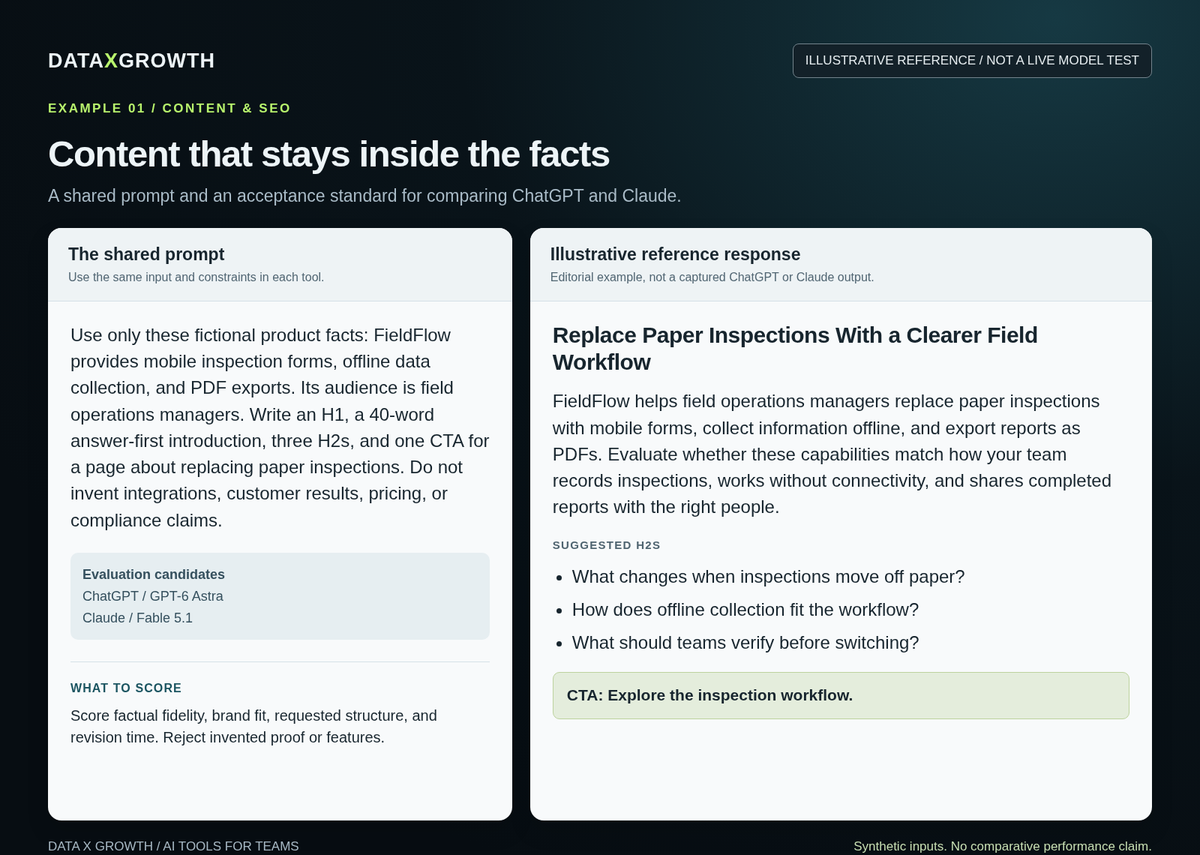
Illustrative reference response, not a captured model result: H1: “Replace Paper Inspections With a Clearer Field Workflow.” Introduction: “FieldFlow helps field operations managers replace paper inspections with mobile forms, collect information offline, and export reports as PDFs. Evaluate whether these capabilities match how your team records inspections, works without connectivity, and shares completed reports with the right people.”
Suggested H2s: “What changes when inspections move off paper?”; “How does offline collection fit the workflow?”; “What should teams verify before switching?” CTA: “Explore the inspection workflow.” The acceptance criteria are factual fidelity, the requested structure, a 40-word introduction, and no invented commercial claims. Use the same standard for both tools.
The underlying discipline is to supply the business context AI needs before the prompt, rather than asking a model to invent your positioning from a keyword.
Marketing analytics and performance interpretation
Analytics is a useful stress test because polished language can hide weak reasoning. Give both tools identical datasets, reporting periods, currency, attribution definitions, and known tracking changes. Require explicit calculations and a separation between observed results, possible explanations, and recommended next steps.
Reconcile calculations with a spreadsheet, query, or independent script. Ask the model to flag missing information instead of filling it in. A recommendation to increase spend should depend on lead quality, marginal economics, and measurement reliability, not only the lowest displayed acquisition cost.
Example 2: campaign efficiency with a tracking caveat
Analyze this synthetic campaign data. Prospecting spent $6,000 and recorded 120 leads. Retargeting spent $2,000 and recorded 80 leads. CRM shows 150 unique leads across both campaigns. Calculate campaign CPLs and spend per CRM-unique lead. Explain what the discrepancy does and does not prove. Give one measurement action and one budget recommendation.
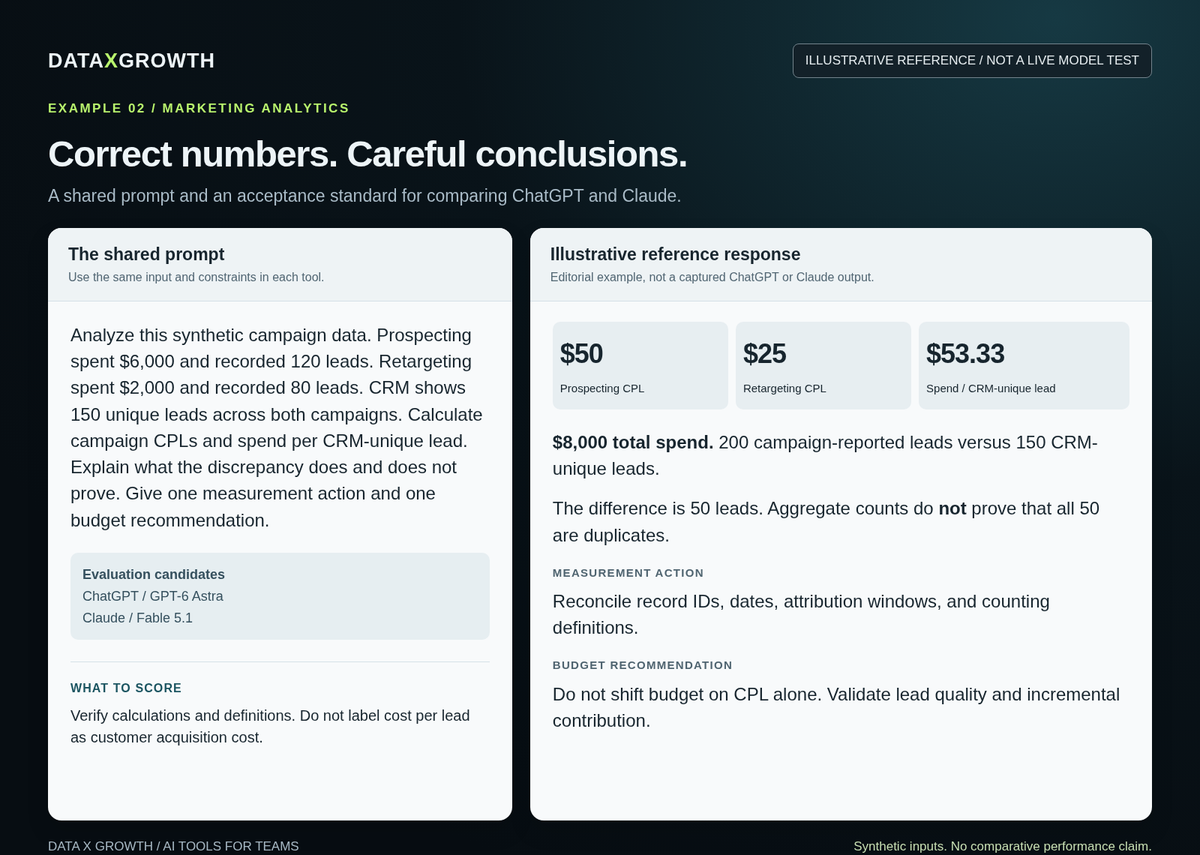
Illustrative reference response, not a captured model result: Prospecting CPL is $50; retargeting CPL is $25. Total spend is $8,000, with 200 campaign-reported leads versus 150 CRM-unique leads. Spend per CRM-unique lead is $53.33. The difference is 50 leads, but these aggregate counts do not establish that all 50 are duplicate records. Attribution windows, qualification rules, reporting dates, and missing CRM records need investigation.
Measurement action: reconcile record-level identifiers, dates, and counting definitions. Budget recommendation: do not reallocate solely because retargeting has a lower reported CPL; validate downstream quality and incremental contribution first. An answer that calls the $53.33 figure customer acquisition cost should fail, because the input contains leads rather than customers.
Research quality and source verification
Run two distinct research tests. In the first, give each tool a fixed set of sources and no external retrieval. In the second, let each product use its native research capabilities. The first examines synthesis and source fidelity; the second evaluates the whole research experience. Combining the results would obscure whether a difference came from reasoning or access to better information.
Verify every consequential citation. Does it support the exact claim? Is the page current? Does it describe general availability, a preview, or a future plan? An answer should not turn a roadmap announcement into an existing feature. For competitor research, require a date, source, uncertainty note, and a clear boundary between evidence and interpretation.
Website development, technical SEO, and automation
Use a bounded implementation task: review a landing-page component, diagnose an event-tracking issue, or propose a structured-data correction. Provide the relevant code, acceptance criteria, and permission limits. Measure working output, test evidence, maintainability, and the accuracy of the completion report.
Do not equate code generation with deployment. A trustworthy workflow should distinguish “proposed,” “implemented locally,” “tested,” and “published.” For publishing and external actions, define explicit approval points. A confident report that says a change is live without verifying the write is an operational failure, even when the proposed code looks correct.
Team knowledge and meeting-to-action workflows
A useful team assistant needs to preserve decisions, distinguish proposals from commitments, and identify missing owners or due dates. Test a realistic combination of meeting notes, project updates, and performance data. Keep source references attached to decisions so a colleague can inspect the evidence without rerunning the conversation.
Example 3: a decision log without invented commitments
Turn these fictional meeting notes into decisions, actions, and open questions. Notes: “Keep spend unchanged until CRM reconciliation. Jamie will audit the form by Friday, September 11, 2026. The team discussed a pricing-page test, but did not approve it. No owner or deadline was assigned to CRM reconciliation.” Do not invent commitments. Do not create tasks in external systems.
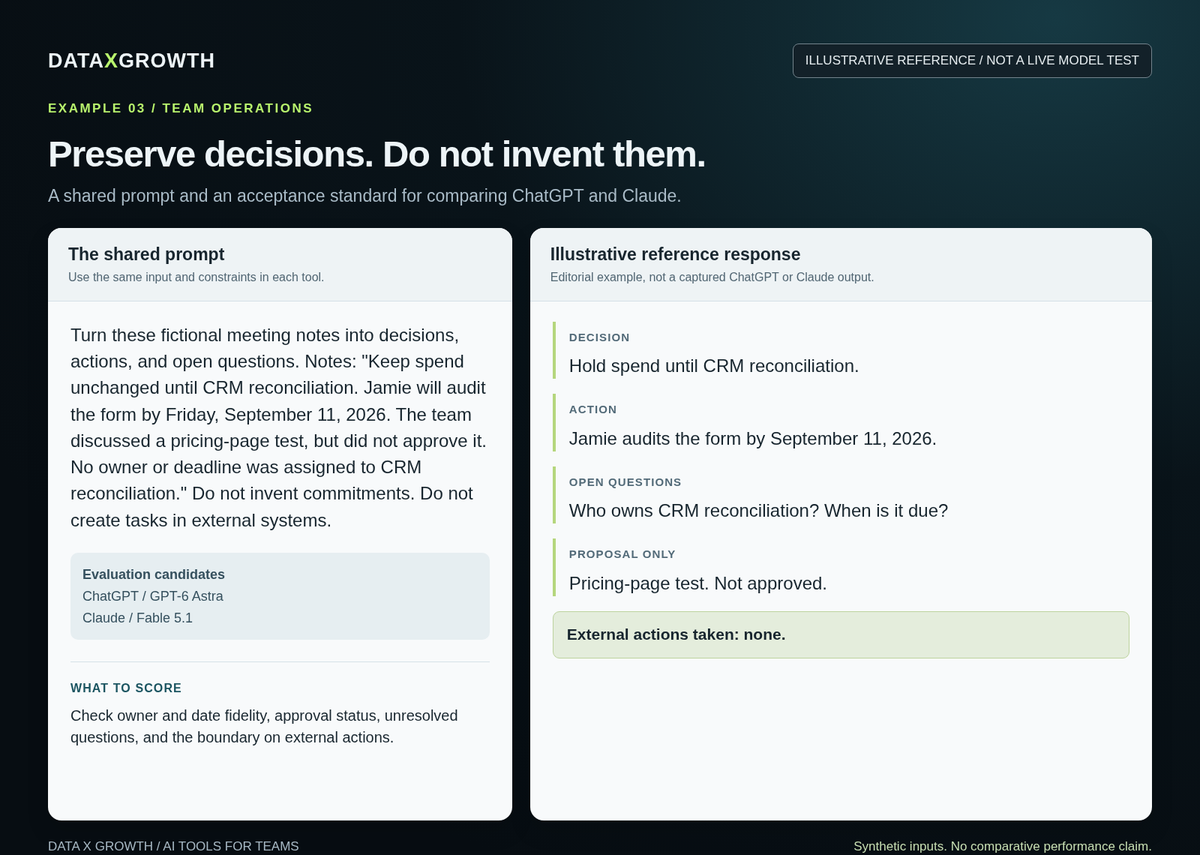
Illustrative reference response, not a captured model result: Decision: hold spend until CRM reconciliation. Action: Jamie audits the form by September 11, 2026. Open questions: who owns CRM reconciliation, and when is it due? Proposal only: pricing-page test; not approved. External actions taken: none. A response that schedules the pricing test or assigns the reconciliation to Jamie would introduce information the notes do not contain.
This is where connecting AI to marketing context and execution becomes more important than collecting additional chat subscriptions.
What do the benchmarks tell us?
OpenAI's published comparison reports Astra at 41.4% and Fable 5.1 at 31.4% on AutomationBench, while Fable is ahead on Humanity's Last Exam with tools, 65.0% versus 57.2%. Attribute these figures to the published evaluation, not to DataXGrowth testing. OpenAI notes that evaluation conditions can differ from production ChatGPT. Source: OpenAI evaluation tables and notes.
A benchmark answers a bounded question under a particular setup. Before treating it as purchasing evidence, check the task, scoring method, effort settings, tools, sample size, and cost. A model's score on a difficult reasoning benchmark does not directly measure its ability to produce your weekly marketing report. Use benchmarks to shortlist candidates, then test your actual work.
Privacy, retention, and administration are separate decisions
OpenAI and Anthropic state that their commercial products do not use business inputs and outputs for model training by default. Opt-ins and feedback can have different treatment. These commitments should not be generalized to every consumer account or interpreted as a promise that no data is retained. Sources: OpenAI business data and Anthropic commercial training policy.
Fable 5.1 has an important covered-model retention qualification. Anthropic documents a 30-day retention requirement affecting certain otherwise zero-retention organizations, with exceptions for eligible organizations notified that they can use Fable with zero data retention. Confirm your organization's actual eligibility and deployment terms rather than assuming a standard policy applies. Source: Anthropic covered-model retention.
OpenAI documents retention controls and zero data retention for qualifying API customers. Eligibility and supported features still need review. Source: OpenAI business controls. For either provider, require a documented answer on retention, geographic processing, connector access, identity management, audit logs, and who can approve external actions.
Compare cost per accepted deliverable
Our proposed operating metric is: cost per accepted deliverable equals allocated software and usage costs plus human review and rework costs, divided by the number of accepted deliverables. Keep active employee time separate from elapsed processing time. Include setup and maintenance when comparing complete implementations.
Consider an illustrative task with reviewer time valued at $75 an hour. Workflow A uses $1 of software and requires 12 minutes of review: $16 total. Workflow B uses $2 of software and requires four minutes of review: $7 total. These are hypothetical inputs, not model results. They show why a cheaper response can be a more expensive business outcome.
Other AI models and platforms teams should consider
The relevant alternative may be a different model, an application connected to existing work, or a self-managed deployment. Do not score these as interchangeable products. First decide which layer of the problem needs to change.
Google Gemini: evaluate the Google-centered workflow
Google documents Gemini assistance inside Gmail, Docs, Sheets, Slides, Drive, and other Workspace products, with access depending on the subscription. Separately, developers can evaluate models such as Gemini 3.8 Flash. A Google-centered team should test work in the actual applications it uses, rather than assume an API benchmark describes every Workspace experience. Sources: Workspace documentation and Gemini 3.8 Flash guide.
Microsoft Copilot: evaluate Microsoft 365 context
Copilot is an application and orchestration layer, not one standalone foundation model. Microsoft describes grounding through Microsoft Graph and access limited by the signed-in user's permissions. Evaluate the value of working inside your Microsoft environment, while checking whether existing access permissions expose more organizational material than intended. Source: Microsoft Copilot architecture.
Perplexity: evaluate research and multi-model workflows
Perplexity describes an enterprise platform combining multiple models, external research, files, and connected applications. It is another product-level comparison, rather than a single-model substitute. Test citation support, retrieval relevance, access controls, and the effort required to turn research into accepted work. Source: Perplexity Enterprise.
Grok: evaluate tool-enabled web and X research
Grok 4.6 is documented with configurable reasoning and tool use. Its documentation explicitly says current information requires search tools such as Web Search or X Search. For social and market research, evaluate whether the retrieved evidence is relevant and representative; a visible conversation on X is not automatically evidence of market-wide demand. Source: Grok model documentation.
Mistral: evaluate deployment control and operating responsibility
Mistral documents self-deployment on an organization's own infrastructure. That creates a different decision: how much control do you need, and can your team operate the system? Review the chosen model's license, infrastructure requirements, security, monitoring, and maintenance. Self-hosting is a deployment choice, not an automatic guarantee of privacy or lower total cost. Source: Mistral self-deployment.
Lower-cost models: evaluate whether flagship capability is necessary
Anthropic lists Opus 5 and Sonnet 5 at lower standard token rates than Fable 5.1. Include at least one lower-cost candidate in a pilot for routine extraction, classification, and first drafts. Use the least expensive setup that meets the acceptance threshold, and reserve higher-cost reasoning for the tasks where it demonstrably improves the result. Source: Anthropic pricing.
How to run a fair team evaluation
Start with five representative tasks: a content brief, a campaign analysis, a source-backed research comparison, a technical change, and a meeting-to-action summary. Agree on acceptance criteria before seeing the outputs. Apply mandatory security and access requirements as pass/fail gates, not small weights that a higher writing score can offset.
For controlled tests, use identical files, prompts, permissions, and time limits. Start fresh conversations and record model version, application, effort setting, tools, date, and any memory or custom instructions. Run each task several times; three repetitions can expose obvious inconsistency, but do not establish statistical superiority. Randomize review order and retain failures.
Score factual and numerical accuracy, task completion, source fidelity, review minutes, operational fit, and cost per accepted result. Report median review time and observed failure counts rather than an unexplained overall score. A separate product-native test can then measure the practical benefit of each environment's integrations.
For paired screenshots, show the same prompt alongside the full relevant response, keep the model label and settings visible, and use equivalent crop boundaries. Record whether the view is the first attempt or a revision. Redact private data, disclose redactions, and never reconstruct a polished response and present it as a native product screenshot.
What this means for SEO and GEO workflows
Choosing an AI writing tool does not establish search performance. Google's guidance says foundational SEO practices remain relevant for AI Overviews and AI Mode, with no additional technical requirements or special schema needed. Important information should remain available as text, supported by useful imagery and discoverable internal links. Source: Google Search Central.
Our recommended workflow is to use AI for structured research, briefs, source checks, and revision assistance, then apply human expertise and editorial review. Evaluate content against the reader's decision, not a promise that an “AI-optimized” format will guarantee rankings or citations. Treat visibility, visits, qualified inquiries, and revenue as separate measurements.
Frequently asked questions
Is ChatGPT 6 the same as GPT-6 Astra?
Not exactly. ChatGPT is the application and GPT-6 Astra is the model family discussed here. Record the selected model, plan, tools, and configuration when evaluating an output; distinguish Astra Pro from standard Astra.
Is Claude Fable 5.1 better for writing?
This guide does not establish a universal writing winner. Test the same brief and sources, then compare factual accuracy, brand fidelity, editorial quality, and revision time. A preferred writing style is not evidence of stronger research or better conversion performance.
Which is better for marketing analytics?
Choose based on verified calculations, handling of missing information, source access, and useful next decisions. Test the same dataset and counting definitions. An attractive dashboard or confident explanation is not a substitute for reconciliation.
Does a larger context window guarantee better answers?
No. The published limit describes capacity, not a guarantee of accurate retrieval or reasoning. Test whether the system finds the relevant fact, preserves conflicting evidence, and answers the actual question within your workload.
Should our team subscribe to both?
Only when a second tool produces a measurable benefit that justifies added cost and governance. A practical arrangement may be one approved primary platform plus a specialist option for a defined workflow. Avoid duplicating subscriptions without a clear use case.
Choose the workflow before choosing the winner
Define the work, the information the system can use, and the standard the result must meet. Then test the complete setup. The strongest AI decision is not a permanent allegiance to one brand. It is a repeatable process for selecting the right capability, checking its output, and measuring whether the work improves.
Need help choosing and integrating AI into your marketing workflows? Contact DataXGrowth about Marketing AI Integration Services to evaluate your tools, connect the right business context, and build a practical implementation plan.