
B2B conversion rate optimization is not about changing button colors until a
dashboard moves. It is the disciplined work of finding where qualified demand loses momentum, then testing a clearer path forward.
For SimpleCertifiedMail.com, the first signal looked contradictory. Homepage sessions increased 4.6%, from 7,050 to 7,374. Organic clicks increased 6.1%, from 5,448 to 5,779. Yet homepage conversions declined 11.5%, from 130 to 115.
That pattern changed the question. The business did not simply need more traffic. It needed a homepage that helped more of the existing audience understand the product, trust the process, and take the next step.
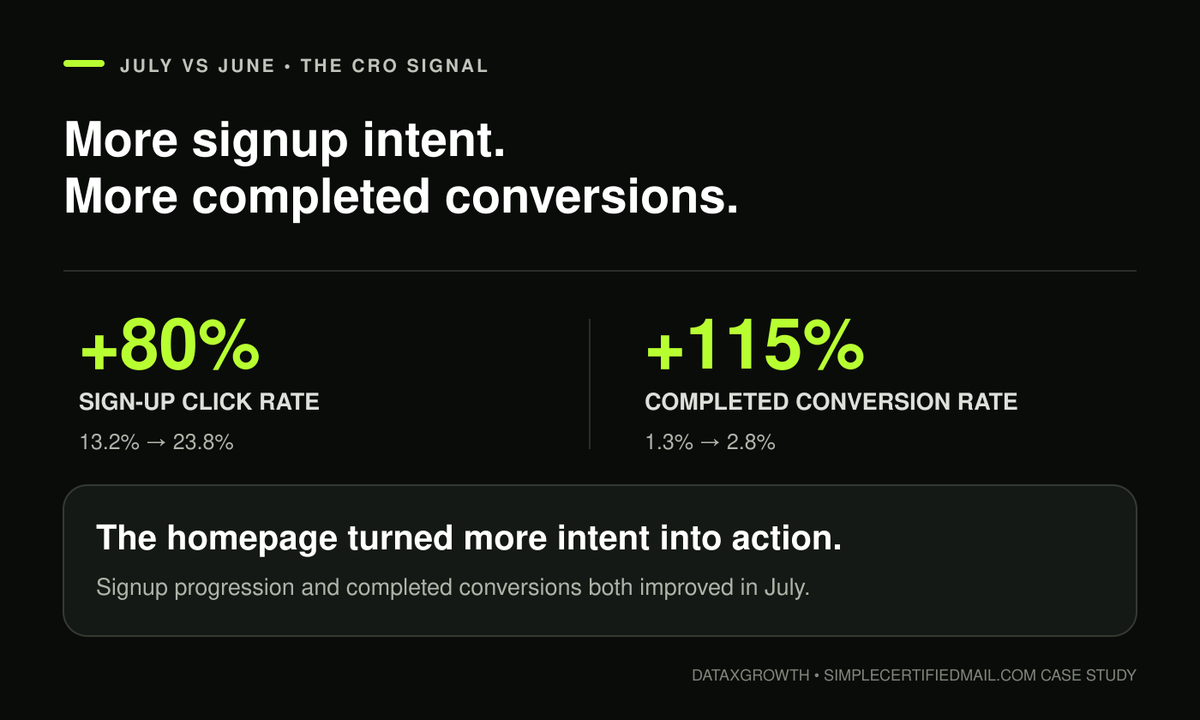
A coordinated homepage variant produced a measured conversion rate of 2.8%, compared with 1.3% for the control. That is a 1.5-percentage-point absolute increase and approximately 115% observed relative lift.
The initial signal: traffic was growing while conversion declined
Traffic growth can hide a conversion problem. A channel report may look healthy while the website produces less value from each visit.
The SimpleCertifiedMail.com funnel readout made the constraint visible:
• Homepage sessions: 7,050 to 7,374, up 4.6%
• Organic clicks: 5,448 to 5,779, up 6.1%
• Homepage conversions: 130 to 115, down 11.5%
When the top of the funnel expands and conversions fall, the next dollar should not automatically go toward acquisition. The stronger move is to inspect what happens after the click.
Why traffic growth did not solve the conversion problem
More visitors create more opportunity only when the experience converts that attention into a meaningful action. In a B2B journey, that requires several things to happen quickly: the visitor must recognize the offer, understand how it works, see evidence that it is credible, and know which action fits their intent.
The earlier homepage had useful information, but the buying path could still make a visitor work too hard. Product details, process education, and trust signals did not always appear at the moment they were most valuable.
That is a classic B2B CRO problem: not a lack of information, but a mismatch between information, hierarchy, and decision timing.
What changed in the homepage variant
The variant was built as a coordinated experience rather than a collection of isolated cosmetic changes. Six principles shaped the new homepage.
1. The hero answered the buyer’s questions faster
The hero was revised to communicate what Simple Certified Mail is, who it helps, and what a visitor can do next. This reduced interpretation time and made the primary action more obvious.
A strong B2B hero should answer three questions within seconds: What is this? Is it relevant to me? What should I do next?
2. Friction-removing details moved closer to the primary CTA
Important process details were placed nearer to the action. Visitors could better understand what would happen after they clicked, reducing uncertainty at the exact point where hesitation can stop a conversion.
CTA copy is only one part of the decision. The surrounding context often determines whether the button feels low-risk and relevant.
3. Trust moved closer to the decision
Credibility cues were positioned closer to the primary conversion area. That matters for a service connected to regulated communications, documentation, and proof of delivery.
Trust should not live in a distant logo strip that visitors may never reach. It should appear beside the claims and actions it supports.
4. The hero became tighter and easier to scan
The revised hierarchy reduced competing messages and gave the primary narrative more visual space. This made the homepage easier to scan for visitors arriving with different levels of product knowledge.
In B2B, clarity often outperforms cleverness because the visitor is trying to qualify the solution quickly.
5. Educational paths moved up the page
Earlier paths were added for visitors researching how Certified Mail works, current Certified Mail costs, and Return Receipt options.
Those visitors may not be ready for the same CTA as someone who already understands the product. By supporting research intent earlier, the page could preserve momentum instead of forcing every visitor into one route.
6. The product was explained before every feature was introduced
The variant prioritized the core product and process before expanding into secondary capabilities. This created a cleaner sequence: understand the offer, see why it is credible, choose a path, then explore more detail.
That sequence reduces cognitive load and gives feature-level information a stronger frame.
The result: 1.3% to 2.8%
At the latest funnel readout, the variant measured 2.8% conversion compared with 1.3% for the control.
• Control conversion rate: 1.3%
• Variant conversion rate: 2.8%
• Absolute increase: 1.5 percentage points
• Observed relative lift: approximately 115%
The practical importance is straightforward: the same demand became more productive. The homepage created more value without requiring a proportional increase in traffic.
What the 115% observed lift does—and does not—prove
The language matters. The 115% figure is an observed relative lift based on the measured rates. It should not be presented as statistically conclusive without the underlying sample counts, confidence interval, test duration, and validity checks.
The test also evaluated a coordinated homepage package. It does not prove that every individual change contributed equally. Clearer messaging, trust placement, CTA hierarchy, and educational pathways worked together in the experience.
What the result supports is a strong directional conclusion: the variant is a better baseline for the next round of learning.
Why this was a B2B conversion rate optimization problem
B2B conversion rate optimization focuses on increasing the percentage of qualified visitors who complete a valuable business action, such as starting a trial, requesting a demo, creating an account, or beginning a transaction.
The work is different from a one-step ecommerce optimization because B2B visitors often have different roles, knowledge levels, risk concerns, and buying timelines. A homepage must serve research, validation, and action without letting those paths compete.
The Simple Certified Mail test improved four jobs at once:
• Clarity: visitors could identify the product and value faster
• Confidence: trust appeared closer to the moment of decision
• Direction: CTA hierarchy made the next step easier to choose
• Intent matching: educational visitors received earlier research paths
This is why strong B2B CRO starts with the funnel rather than the page. The page is redesigned only after the data identifies the constraint.
What to test next on the B2B homepage
The winning variant should become the next control, not the final answer. The next tests can isolate the highest-value questions created by this result.
• Trust placement: compare proof beside the CTA with proof immediately below the hero
• CTA specificity: compare outcome-led copy with generic action copy
• Educational pathways: test the prominence and order of how-it-works, cost, and Return Receipt links
• Post-click activation: measure account starts, completed transactions, and revenue quality—not only homepage clicks
• Audience alignment: compare messaging for high-intent operational users with visitors still researching Certified Mail requirements
These tests would turn the package-level win into a more precise understanding of what creates lift.
A practical B2B CRO process
1. Start with a business conversion, not a page metric. Define the action that creates value and confirm that analytics capture it accurately.
2. Read the funnel. Compare traffic, conversion, and downstream quality to locate the stage losing momentum.
3. Build a hypothesis around visitor friction. Use behavioral evidence, search intent, sales questions, and page structure to explain why the constraint exists.
4. Change the smallest coherent experience. Test a focused variable when possible; use a coordinated package when the page has a structural messaging problem.
5. Evaluate the result rigorously. Review sample size, duration, validity, conversion quality, and segment behavior before declaring a winner.
6. Turn the winner into the next baseline. CRO compounds when every test narrows uncertainty and creates a sharper next question.
B2B CRO is a learning system, not a one-time redesign
The strongest outcome of this homepage work is not only the observed lift. It is a clearer model of how visitors make the decision.
Traffic was growing, but the experience was not converting that attention efficiently. The variant reduced the gap by improving clarity, trust, hierarchy, and intent matching. Now the business has a stronger baseline and a more useful testing roadmap.
That is the real promise of B2B conversion rate optimization: more value from existing demand and better evidence about what the market needs next.
Frequently asked questions
What is B2B conversion rate optimization?
B2B conversion rate optimization is the process of increasing the percentage of qualified website visitors who complete a valuable business action. It combines funnel analysis, user research, messaging, UX, analytics, and controlled experimentation.
How do you calculate B2B conversion rate?
Divide the number of completed conversions by the number of eligible visitors or sessions, then multiply by 100. Keep the denominator consistent when comparing variants.
What is a good B2B conversion rate?
There is no universal benchmark. A useful rate depends on traffic quality, offer complexity, buying stage, price, conversion definition, and sales process. Your strongest benchmark is usually your own validated baseline.
Which B2B homepage elements should be tested first?
Start with elements tied to the identified constraint: value proposition clarity, primary CTA, trust proof, audience pathways, form friction, and the transition to the next step.
How long should a B2B CRO test run?
Long enough to capture a representative business cycle and enough eligible traffic to support the planned statistical method. Do not stop solely because an early dashboard shows a large difference.
Turn your existing demand into more pipeline
If your acquisition channels are growing while conversion efficiency is flat or declining, the constraint may be after the click.
DataXGrowth helps B2B teams connect funnel analysis, analytics, messaging, UX, and experimentation into a repeatable growth system.
Explore our B2B conversion rate optimization services: https://dataxgrowth.com/services/cro-experimentation/b2b-conversion-rate-optimization
Request a Growth Audit to identify the highest-leverage conversion opportunities in your funnel.