
I have worked in SEO for more than 15 years, which means I have also watched people declare it dead for more than 15 years.
Social media was going to kill it. Featured snippets were going to kill it. Zero-click results were going to kill it. Now AI Overviews, AI Mode, ChatGPT, and other LLM-driven experiences are supposed to finish the job.
But “Is SEO dead?” is the wrong question.
The better question is:
Which parts of SEO still create value when the routine work becomes easier to automate and discovery happens across more surfaces?
Technical checks, metadata, internal-link suggestions, content briefs, first drafts, and recurring reports can already be produced faster than they could a few years ago. Website platforms and development agents will continue absorbing more crawlability, schema, sitemap, redirect, performance, and accessibility work into the baseline build.
That does not eliminate SEO. It exposes the difference between mechanical SEO production and actual search strategy.
SEO isn’t dead. The version that treated people as search volume and content as inventory is losing relevance.
What replaces it is a better marketing channel: one that starts with the user, requires the company to build a credible brand, connects content to the buying journey, and measures more than rankings.
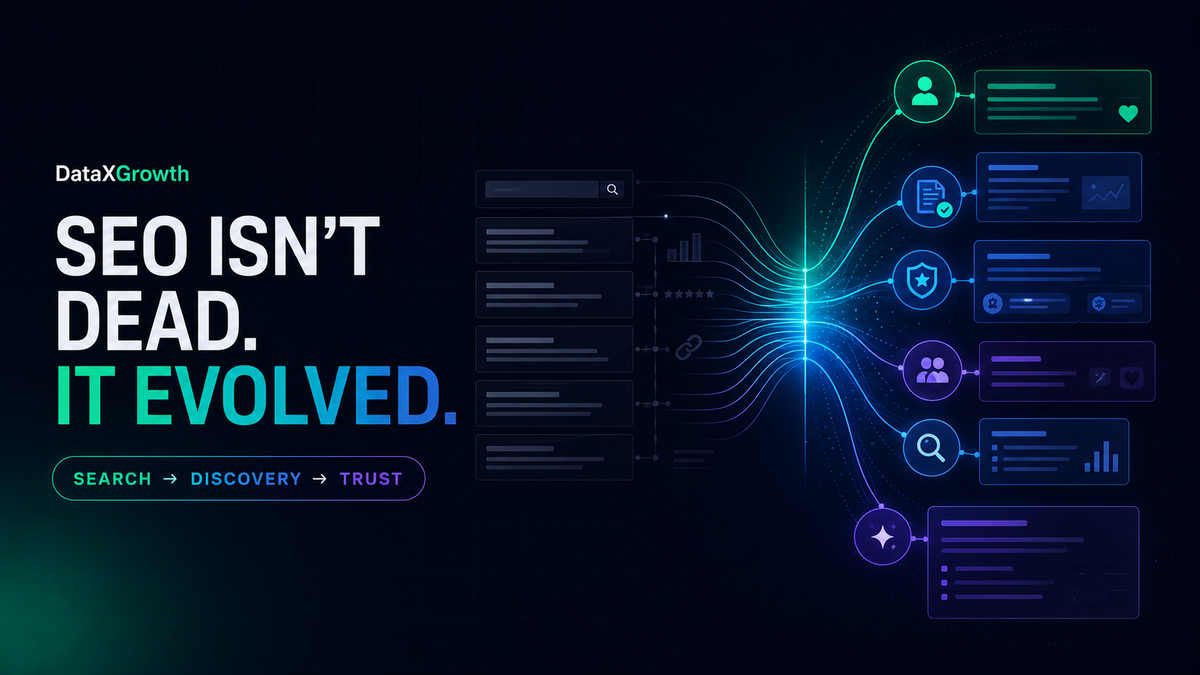
AI is not ending search. It is widening the discovery layer.
Search used to be described as a fairly direct sequence: someone entered a keyword, reviewed a list of links, clicked a page, and took an action.
That journey is now distributed across classic search results, AI-generated answers, video, social platforms, communities, review sites, comparison pages, and branded follow-up searches. A buyer may discover a category in an LLM, validate the options in Google, read community discussions, visit two product pages, and return through a branded query days later.
Organic discovery is not confined to a single results page anymore.
Google’s own guidance for AI features in Search reinforces this point. AI Overviews and AI Mode are part of Search, and the core technical requirements and SEO best practices still apply. There is no special markup that suddenly replaces a crawlable site, useful content, clear internal links, or a strong page experience.
The opportunity has expanded beyond ranking one URL for one phrase. A brand can now be discovered as a source, used as supporting evidence, included in a comparison, or surfaced as a credible option across multiple environments.
SEO creates the accessible, understandable foundation. GEO and AEO extend the work by making the brand’s entities, expertise, evidence, and answers easier for generative and answer systems to interpret and cite.
These are not competing disciplines. They are layers of the same discovery system.
The user matters more than the keyword.
Keywords are not disappearing. They still reveal demand, intent, customer language, category terminology, and the questions people ask.
But a keyword is an input. It is not a strategy.
Old SEO often started with an export: find the terms with enough volume, group them into clusters, assign a page to each cluster, and produce content until the roadmap was complete.
Modern organic strategy has to ask harder questions:
- What is the person actually trying to accomplish?
- What do they already understand?
- What uncertainty is preventing the next decision?
- Which alternatives are they evaluating?
- What evidence would make our answer more credible?
- Does this topic connect to a product, service, or market where the business has a legitimate right to compete?
Even Google Search Essentials combines both sides of the equation: use the words people use to find your content, but create helpful, reliable, people-first information and make the site easy to discover and navigate.
The target phrase still matters. It just cannot be the reason the page exists.
Old SEO asked, “How do we rank for this term?”
Modern SEO asks, “What does this audience need to confidently take the next step, and how do we become the most credible answer?”
Old SEO vs. modern SEO and GEO
The difference is not that every old tactic was wrong. It is that the center of gravity has changed.
Starting point
- Old SEO default: Keyword volume
- Modern SEO/GEO approach: Audience problems, intent, entities, and journeys
- Why the shift matters: Content aligns with real decisions rather than isolated queries
Content plan
- Old SEO default: Publish more pages
- Modern SEO/GEO approach: Build differentiated topic authority and useful experiences
- Why the shift matters: Generic content is cheap to produce and difficult to defend
Optimization target
- Old SEO default: One ranking page
- Modern SEO/GEO approach: A connected brand and information ecosystem
- Why the shift matters: Search and AI systems synthesize signals across multiple sources
Authority
- Old SEO default: Backlink quantity and domain metrics
- Modern SEO/GEO approach: Relevant links, expert identity, earned mentions, reviews, citations, and proof
- Why the shift matters: Authority has to be corroborated, not merely claimed
Success measure
- Old SEO default: Rankings and organic sessions
- Modern SEO/GEO approach: Qualified visibility, engagement, assisted conversion, pipeline, and revenue
- Why the shift matters: Traffic without business impact is not a durable strategy
Team ownership
- Old SEO default: The SEO team
- Modern SEO/GEO approach: SEO, content, product, PR, customer, analytics, design, and engineering
- Why the shift matters: Brand discoverability is a company capability
This is why “doing more SEO” is no longer a sufficient plan. A company can publish hundreds of technically optimized pages without creating a single reason for a customer—or an AI answer system—to prefer its perspective.
Automation lowers the floor. Strategy raises the ceiling.
The baseline work still matters.
A page that cannot be crawled, indexed, rendered, understood, or navigated is not going to perform because the strategy behind it was sophisticated. Technical SEO remains the infrastructure that makes organic visibility possible.
But infrastructure is becoming more standardized.
AI tools can identify missing metadata, surface broken links, suggest internal-link targets, classify keywords, draft schema, summarize performance, and produce a reasonable first version of common content. CMS platforms and development agents will get better at preventing basic SEO errors before a page launches.
Some of that should have been standard all along.
The mistake is assuming that automating implementation also automates judgment.
A technically optimized website is not the same as a strategically optimized business.
A system can identify that a page is missing. It cannot automatically determine whether the company has the expertise, evidence, economics, sales support, and brand credibility to win the market that page represents.
It can generate a comparison article. It cannot decide which competitor differences matter to real customers or whether the company can prove the claims it wants to make.
It can recommend more content. It cannot determine whether content is the constraint—or whether the real problem is the offer, positioning, product experience, distribution, conversion path, or measurement system.
That is where experienced SEO leaders are being pushed upward: toward organic growth strategy, audience insight, digital discoverability, cross-functional prioritization, and better business decisions.
Brand is becoming the discoverability moat.
The rise of LLMs makes brand building more important, not less.
Generative systems assemble answers from patterns, entities, claims, and evidence found across their available sources. The exact weighting and retrieval mechanisms vary by platform and query, but the operational implication is straightforward: a company is easier to understand and recommend when its identity, expertise, category, products, and claims are clear and consistently corroborated.
A website cannot manufacture that trust by repeatedly calling the company an industry leader.
Brand authority is built through connected evidence:
- A clear category and defensible point of view.
- Recognizable experts with demonstrated experience.
- Original research, benchmarks, experiments, and useful tools.
- Specific case studies and verifiable customer outcomes.
- Consistent product, service, and entity information across the website and third-party sources.
- Relevant media coverage, partnerships, reviews, citations, and earned links.
- Useful participation in the communities where the audience already learns and compares options.
This is also why generic AI content is strategically weak. If the page simply reorganizes information that already exists everywhere else, it may be accurate, but it gives users and discovery systems no strong reason to choose it.
Google’s current guidance for optimizing for generative AI features explicitly recommends non-commodity, expert-led content that adds value beyond common knowledge. That is not a new technical trick. It is a demand for better marketing.
If your brand exists only on your own website, search engines and answer engines have very little independent evidence that it deserves to be recommended.
The execution playbook has changed.
The modern approach still uses familiar SEO disciplines, but it applies them differently.
Keyword research
- Legacy execution: Export terms and group them by volume
- Modern SEO/GEO execution: Map customer language to problems, entities, funnel stages, and commercial relevance
Content creation
- Legacy execution: Summarize what already ranks
- Modern SEO/GEO execution: Add firsthand expertise, original data, examples, tools, comparisons, and decision support
On-page optimization
- Legacy execution: Repeat target phrases in prescribed locations
- Modern SEO/GEO execution: Make the topic, answer, evidence, and next step unambiguous for people and machines
Link building
- Legacy execution: Pursue links as an isolated authority metric
- Modern SEO/GEO execution: Earn relevant references through expertise, partnerships, PR, research, and genuinely useful assets
Structured data
- Legacy execution: Add schema as a checklist item
- Modern SEO/GEO execution: Clarify entities, relationships, authorship, products, services, and evidence consistently
Distribution
- Legacy execution: Publish and wait for rankings
- Modern SEO/GEO execution: Reinforce ideas across owned, earned, social, community, and partner channels
Reporting
- Legacy execution: Track rankings and last-click organic traffic
- Modern SEO/GEO execution: Measure search visibility, AI citations and mentions, branded demand, assisted journeys, conversion, pipeline, and revenue
The key shift is from isolated page optimization to connected market evidence.
A strong article is more valuable when it supports a product page, gives the sales team a useful explanation, creates a point of view for LinkedIn, earns references from industry sources, answers real customer objections, and provides structured evidence that search and AI systems can understand.
That is a marketing asset. It is not merely “SEO content.”
Better SEO looks like a connected growth system.
This is why DataXGrowth treats SEO and AEO as part of a broader growth operating system rather than an isolated traffic program.
The work follows a practical loop:
- Diagnose: Find the audience, discovery, technical, content, conversion, and measurement constraints.
- Prioritize: Rank opportunities by business value, customer relevance, authority fit, and the ability to produce a differentiated answer.
- Execute: Build the content, evidence, technical structure, distribution, and conversion path together.
- Measure: Connect visibility to qualified engagement, assisted journeys, pipeline, revenue, and what the team should learn next.
SEO, GEO, CRO, analytics, PR, design, and development do not need to become one job. They do need to work from one strategy.
When they operate separately, the SEO team can generate traffic that does not convert, the brand team can create messaging no one discovers, the development team can launch pages that remove valuable content, and the analytics team can report outcomes without explaining what caused them.
When they operate as a system, organic discovery becomes more useful to both the customer and the business.
What teams should do now
The next version of an organic growth program should make six changes:
- Automate routine work without outsourcing judgment. Use AI to accelerate audits, classification, research, briefs, and production, but keep strategy, evidence, prioritization, and approval human-owned.
- Replace keyword-only roadmaps with audience and entity maps. Connect queries to customer problems, decision stages, products, experts, proof, and commercial value.
- Audit brand corroboration. Identify the claims made on the website and determine whether customers, partners, publications, experts, and communities independently support them.
- Invest in non-commodity content. Create research, case studies, benchmarks, tools, experiments, frameworks, and expert analysis that competitors and generic AI systems cannot cheaply reproduce.
- Design for the next decision. Every priority page should help the user understand the issue, evaluate the available choices, reduce risk, and take a logical next step.
- Measure the full discovery journey. Track traditional search performance alongside AI visibility, branded demand, assisted conversions, pipeline influence, and revenue.
None of this means abandoning keywords, technical SEO, internal links, schema, or performance. It means putting those tactics in service of a larger goal.
SEO is becoming harder—and more valuable.
The easy parts of SEO will continue becoming easier.
The strategic parts will become more important because the internet is filling with technically acceptable, instantly generated content. When everybody can produce a page, the advantage moves to the companies that understand the customer, have something original to contribute, can prove their claims, and connect discovery to a useful experience.
That is not the death of SEO.
It is SEO becoming what a strong marketing channel should have been all along.
The future of SEO is not more content for algorithms. It is better marketing for people—structured clearly enough that search engines and AI systems can recognize the value.
If your team needs to understand where its search, AI visibility, content, technical foundation, conversion paths, and measurement system are disconnected, start with a DataXGrowth Growth Audit. We will identify the most important constraints and build a prioritized roadmap around the opportunities that can actually move growth.