
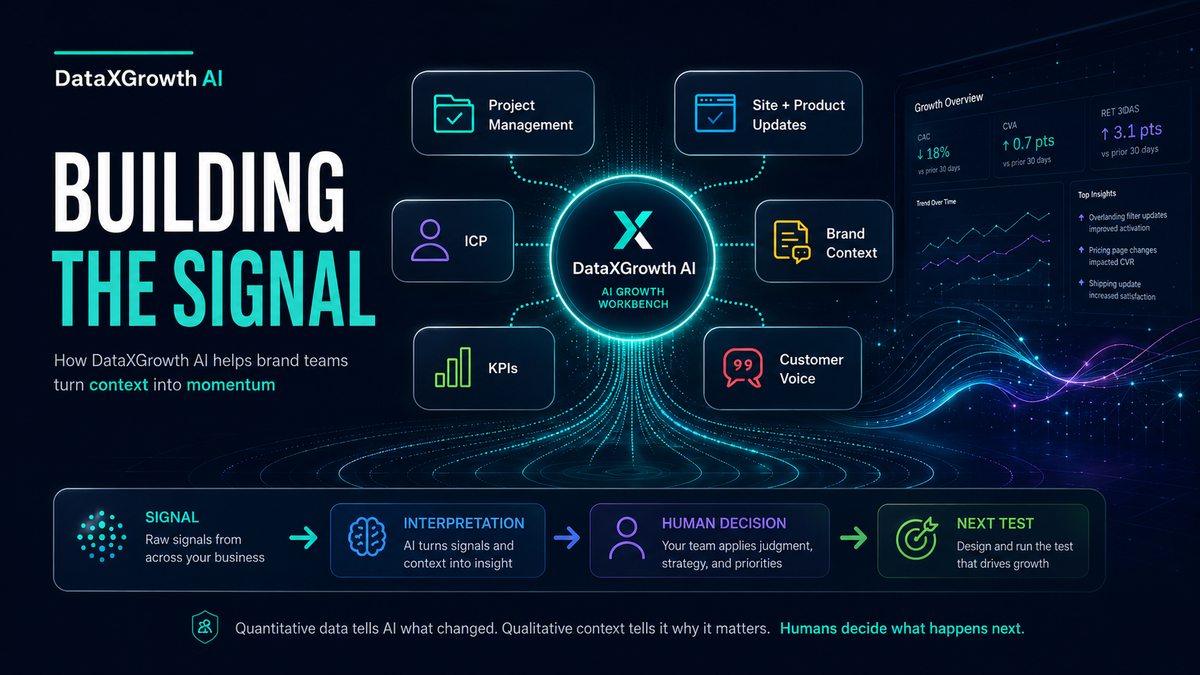
Most teams start using AI for marketing in the wrong place.
They begin with a prompt: “Review our marketing performance and tell us what to improve.” Then they attach a dashboard export and expect the model to understand the business behind it.
The AI can see spend, traffic, leads, conversion rate, CAC, pipeline, and revenue. What it usually cannot see is the context that makes those numbers meaningful.
The landing page changed last Tuesday.
- The sales team changed the definition of a qualified lead.
- A tracking issue is still open.
- The target customer shifted after a recent strategy meeting.
- A campaign is intentionally prioritizing market learning over short-term efficiency.
- Customers keep repeating the same objection in sales calls and support conversations.
Without that context, AI can summarize the numbers. It cannot reliably understand the business.
A metric movement is an alert. Context turns it into a usable signal.
The first step is not prompting. It is context architecture.
A useful AI-assisted growth program needs two different kinds of signal.
The market signal
This is a meaningful change in customer or business behavior: qualified pipeline declined, product-page conversion increased, CAC rose, returns changed, one ICP began converting faster, or a new objection started appearing repeatedly.
The AI signal packet
This is the structured context the model needs to interpret the market signal responsibly.
Paid-search CAC increased 22% during the last 14 days. A new form launched four days before the increase. Mobile completion declined more than desktop. Sales says lead quality is unchanged. No campaign targeting changes were made. A tracking QA task remains open. The business goal is qualified pipeline, not raw lead volume.
The first version is a notification. The second gives AI enough business, operational, and customer context to help the team investigate.
Build a persistent AI growth project for each brand
The foundation should be a persistent, brand-specific workspace—not one oversized prompt and not an unstructured dump of documents.
The workspace gives AI stable business context and continuously updated operating context. It should be separated by brand, owned by humans, and organized around the decisions the marketing team needs to make.
1. Business and brand overview
Document the business model, products, pricing, sales motion, company stage, positioning, value proposition, brand voice, approved claims, prohibited claims, proof points, and strategic constraints.
2. ICP and customer context
Define high-fit and low-fit segments, buyer roles, user roles, pain points, triggers, objections, alternatives, proof requirements, buying process, and the language customers use naturally.
3. KPI dictionary
Every primary, secondary, leading, and guardrail metric should include its business meaning, formula, data source, owner, reporting window, baseline, target, warning threshold, exclusions, and known tracking limitations.
4. Active campaigns and experiments
Track the channel, audience, offer, message, hypothesis, launch date, budget, primary KPI, guardrail KPI, status, and decision rule for every meaningful test.
5. Site and product change log
Record page launches, form changes, CTA updates, pricing changes, tracking deployments, technical fixes, navigation changes, product releases, merchandising changes, and onboarding or checkout changes.
6. Voice of customer
Connect sales calls, customer interviews, support tickets, reviews, surveys, email replies, ad comments, lost-deal reasons, return reasons, and community discussions.
7. Project and decision memory
Keep active work, owners, due dates, blockers, shipped work, approvals, assumptions, test results, accepted recommendations, rejected recommendations, and unresolved questions in the same operating context.
Qualitative data is the meaning layer
Qualitative marketing data is often treated as soft or secondary. In practice, it is frequently the layer that gives quantitative performance its business meaning.
Quantitative data can tell the team that conversion declined, CPA increased, organic traffic fell, one segment converted faster, email revenue improved, or returns rose.
Qualitative context can reveal why customers hesitated, which promise they misunderstood, why sales rejected the leads, what changed on the site, what work is blocked, what the brand will not claim, and what proof the buyer still needs.
AI should not treat qualitative evidence as unquestionable truth. It should use that evidence to generate better explanations, identify missing information, and propose better questions for the human team.
Connect project management to marketing performance
A performance number cannot be interpreted correctly without knowing what the team shipped. Project-management data gives AI the chronology of the marketing program.
What launched and when
- What is blocked or delayed
- Which page, campaign, product, or KPI the work affects
- Who owns the next action
- What hypothesis motivated the work
A dashboard may say landing-page conversion increased 14%. Project context may show that a new proof section and shorter form launched eight days earlier. Customer context may show that trust and implementation risk had been recurring objections. AI can now identify a plausible relationship, preserve the caveat that correlation is not proof, and recommend a controlled follow-up test.
Build a client context model, not a rigid intake form
One lesson from building DataXGrowth AI was that the client profile could not be locked to one industry or reduced to fixed dropdowns.
Dropdowns are useful when the option set is truly fixed. They are weak substitutes for customer nuance, strategic intent, and vertical-specific constraints. The better model has two layers.
Universal core context
Business overview, website, business type, growth motion, reporting objective, north-star KPI, primary and secondary KPIs, ICP, products, competitors, active campaigns, reporting preferences, and human-approval requirements.
Brand- or vertical-specific context
Regulatory requirements, inventory constraints, SaaS activation events, marketplace liquidity, multi-location capacity, legal review, seasonal demand, industry qualification rules, and other context that only applies to that brand.
The rule is simple: if the field applies to nearly every brand, it belongs in the core. If it only makes sense for a particular business model or vertical, it belongs in the custom layer.
How we are building this into DataXGrowth AI
We are building DataXGrowth AI as an intelligence layer for brand teams—not as an autonomous replacement for marketers.
The product direction is to connect client performance data with the context required to interpret it, then deliver an evidence-based draft insight for strategist review.
Client-specific profile
The AI begins with the brand overview, ICP, KPIs, products, competitors, campaigns, reporting preferences, and custom business context.
Connected performance data
Advertising, analytics, search, CRM, ecommerce, revenue, and manual data sources provide the quantitative layer. Each client’s data needs to be separated and actually available to the analysis layer—not merely attached through an authenticated connector.
Operational context
Asana or another project-management system provides current task status, shipped work, blockers, owners, and dependencies. Slack and meetings add discussion context, but task state should live in the operational source of truth.
Meeting and customer context
Fathom, sales conversations, client meetings, support interactions, reviews, and other voice-of-customer sources help the system understand priorities, objections, decisions, and buyer language.
AI-assisted interpretation
The system should help answer: What materially changed? Why does it matter for this brand? What evidence supports the explanation? What contradicts it? What is still unknown? What should the team inspect or test next?
Human review and action
A DataXGrowth strategist reviews the evidence, corrects the interpretation where necessary, and approves what becomes client-facing. The approved insight can then become a Slack update, weekly report, Asana task, site recommendation, campaign test, tracking request, or question for the brand team.
We started with a single-client-first approach because the feedback loop matters. The system needs real corrections from people who understand the client before it can become a reusable multi-brand operating model.
What momentum looks like for a brand team
Marketing momentum does not come from generating more assets. It comes from carrying learning forward without forcing the team to reconstruct the business every week.
The weekly review begins with the current strategy, not a blank page.
- A new metric change is compared against recent launches and known constraints automatically.
- Customer questions are preserved and fed into messaging, content, offers, and product education.
- Rejected ideas and failed tests remain part of the company’s memory.
- Handoffs improve because the reason behind a decision travels with the task.
- The team spends less time collecting context and more time deciding what deserves action.
The result is not fully automated marketing. It is a stronger organizational memory and a faster human feedback loop.
Worked example: from raw metric to context-rich signal
Raw alert
Paid-search cost per conversion increased 24%.
Context added
Qualified pipeline remained flat. Brand campaign performance did not change. Non-brand conversion declined. A new landing-page form launched six days ago and added two required questions. Mobile completion fell more than desktop. Sales says lead quality did not improve. A mobile form QA task is still open. No meaningful audience or bid-strategy changes occurred. The company’s primary objective is qualified pipeline, not raw lead volume.
AI-assisted interpretation
Observed fact: Non-brand conversion declined after a form update, with a larger decline on mobile.
Plausible explanation: The additional fields may be creating mobile friction without producing higher-quality leads.
Contradicting evidence: Search-term mix or tracking could also explain part of the decline.
Missing data: Form-start versus completion rate, validation errors, conversion by search term, and CRM qualification by pre- and post-launch cohort.
Recommended next step: Run a controlled mobile form-friction test while preserving qualification requirements for a defined audience.
Human decision: The strategist decides whether the qualification questions are commercially necessary and whether the test is safe.
Build reusable AI skills around specific growth jobs
Do not ask one general-purpose agent to “do marketing.” Build narrow workflows that operate against the same approved brand context.
Context curator: Finds missing fields, stale assumptions, and conflicting documentation.
- KPI signal analyst: Detects material changes and applies the correct definitions and guardrails.
- Launch context mapper: Matches shipped work to campaigns, pages, products, and KPIs.
- Voice-of-customer synthesizer: Clusters pains, triggers, objections, and proof gaps using real customer language.
- Experiment designer: Converts a signal into a hypothesis, test, primary KPI, guardrails, and decision rules.
- Weekly growth reviewer: Summarizes what launched, what changed, what was learned, and what should happen next.
Human judgment is part of the architecture
AI should help with retrieval, synthesis, theme detection, anomaly detection, comparison, drafting, prioritization, memory, and repetitive reporting preparation.
Humans should continue to own business goals, KPI definitions, brand judgment, customer interpretation, causal conclusions, risk, budget, experiment approval, client communication, and final strategic direction.
Human judgment is not a fallback for weak AI. It is part of the system architecture.
The safest operating model begins with draft-only analysis. A strategist approves, edits, rejects, or requests more evidence. The system then records the correction so the brand context and decision memory improve over time.
A practical 30-day setup
Days 1–7: Establish the human-owned context
Build the business profile, brand overview, ICP, KPI dictionary, constraints, reporting objective, and approval rules.
Days 8–14: Connect the operating systems
Connect project management, analytics, advertising, CRM, site updates, meetings, and customer feedback. Document the owner, source of truth, refresh cadence, and known limitation for each source.
Days 15–21: Create the signal workflows
Build the KPI signal detector, launch mapper, customer-language workflow, standard signal packet, experiment template, and weekly review format.
Days 22–30: Run human-reviewed digests
Review accuracy, evidence quality, missing context, unsupported assumptions, strategist edit rate, usefulness, and the actions created. Use those corrections to improve the profile and workflows.
The context-audit prompt
Before asking AI for strategy, use a context audit to determine whether the system has enough information to interpret performance responsibly.
Act as a growth-context auditor. Review the business overview, brand and positioning, products and pricing, ICP and buying process, KPI definitions, active campaigns, recent site and product changes, project status, customer and meeting feedback, tracking issues, and operating constraints. Return what is complete, missing, stale, contradictory, or unsupported. Identify metrics without clear definitions, changes without dates, qualitative sources that should be connected, risks of drawing conclusions, and questions a human strategist must answer. Do not recommend strategy until the context gaps are explicit.
The goal is not autonomous marketing
The first step in AI-assisted growth is creating a context system the model can responsibly use.
That system connects project work, site changes, ICPs, brand strategy, KPI definitions, customer language, campaign results, and human decisions.
AI can retrieve the information faster, detect patterns faster, summarize meetings faster, and draft explanations and experiments faster. The brand team still defines the business, listens to customers, evaluates risk, and decides what the evidence means.
The result is a better-informed marketing team with a stronger memory, a faster feedback loop, and more time for judgment.
Human-defined context → AI-assisted interpretation → human-owned decision.